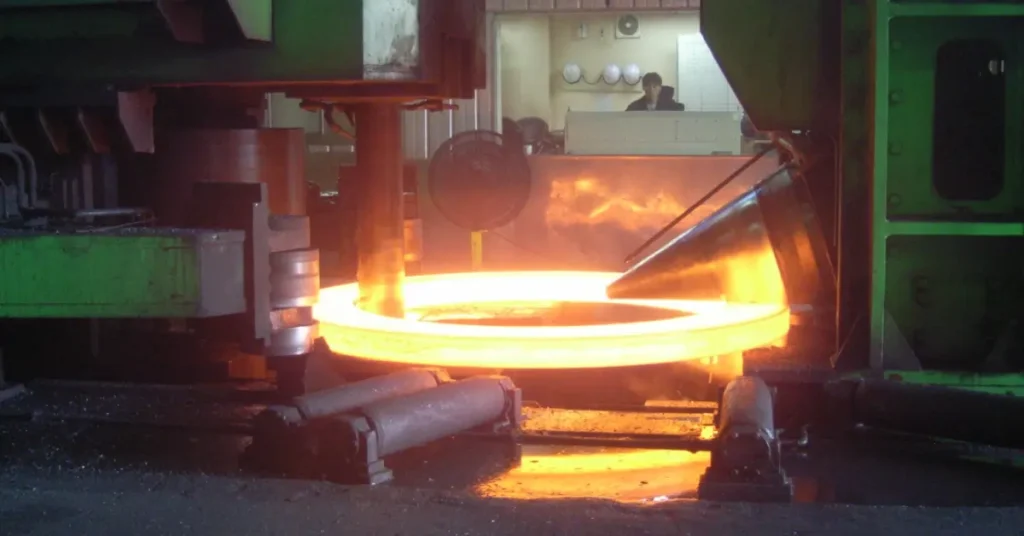
For engineers and procurement teams sourcing precision components, seamless rolled ring forging is one of the most reliable methods available. It produces parts with a continuous grain structure, no welded seams, and tight dimensional control. Whether you are specifying flanges, bearing races, gear blanks, or pressure vessel rings, understanding the process behind seamless ring forging helps you write better specifications and avoid costly surprises on delivery.
This guide covers every stage of the process, the most common materials, and the tolerance standards that govern industrial supply.
What Is Seamless Rolled Ring Forging?
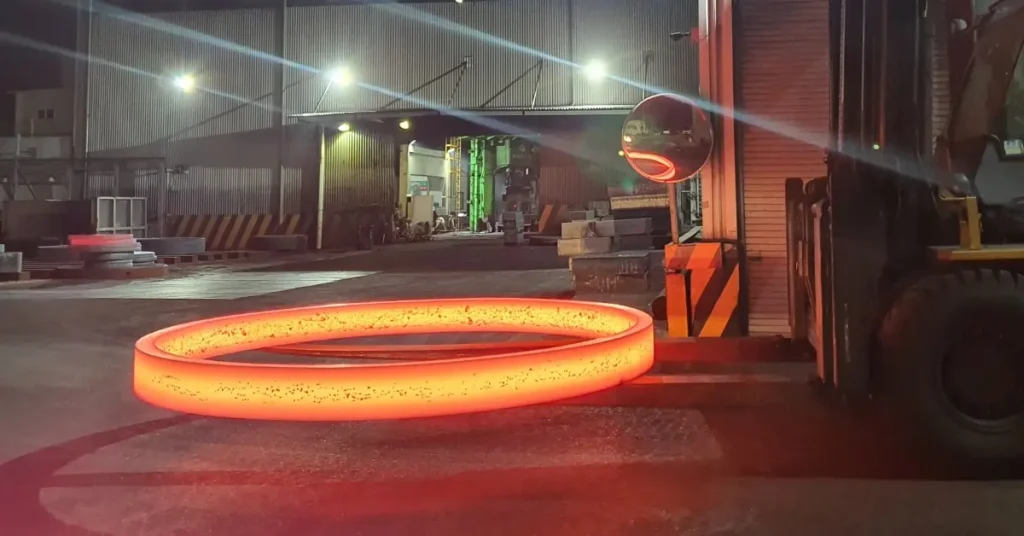
Seamless rolled ring forging is a hot-working process in which a pre-formed donut-shaped blank is placed between a driven roll and an idler roll. As the rolls rotate and apply radial pressure, the wall of the ring thins while the diameter grows. The result is a seamless ring with a refined, directional grain flow that follows the circumference of the part.
Because no material is removed to create the hole and no seam is welded shut, the mechanical properties of a forged ring are fundamentally different from those of a machined ring cut from bar stock or a rolled and welded cylinder. The grain structure runs around the circumference rather than being interrupted, which gives forged rings superior fatigue resistance and tensile strength under cyclic loading.
The Seamless Ring Rolling Process Step by Step
1. Billet Selection and Heating
The process begins with a solid billet, cut to a weight that accounts for material lost during subsequent operations. The billet is heated to forging temperature in a controlled furnace. For carbon steel this is typically between 1,150 and 1,280 degrees Celsius. The temperature window is critical: too cold and the metal cracks; too hot and grain growth degrades the final properties.
2. Upsetting and Punching
The heated billet is upset (compressed axially) to increase its diameter and reduce its height, then a mandrel punches a hole through the center. The resulting shape is the starting donut, often called a preform or pierced blank. The hole diameter and wall thickness at this stage set the limits for the finished ring geometry.
3. Ring Rolling
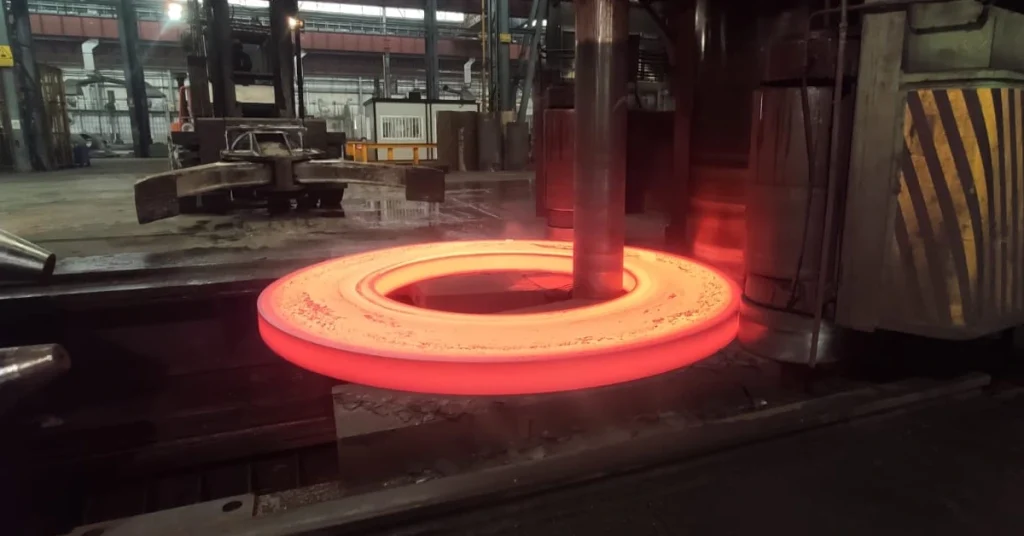
The preform is placed on the ring rolling mill. The main roll applies radial force from the outside while the mandrel roll bears against the inner wall. As the ring rotates, axial rolls control the height, keeping the ring flat as it expands outward. Rolling is typically performed in multiple passes with the ring reheated between passes for larger dimensions.
4. Controlled Cooling and Heat Treatment
After rolling, rings are cooled in a controlled manner to minimize residual stress. Depending on the specification, rings may then receive heat treatment. Normalizing refines grain size. Annealing softens the material for further machining. Quench and temper cycles are applied when the finished part must meet specific hardness or impact requirements.
5. Rough and Finish Machining
The as-rolled ring is oversized to allow for machining stock. Rough turning removes the scale and brings the ring close to finished dimensions. Finish turning achieves the specified tolerances. Some rings are also bored, faced, or profiled to a cross-section other than a plain rectangular shape.
Materials Used in Seamless Ring Forging
The choice of material depends on the operating environment, the required mechanical properties, and the applicable design standard.
- Carbon steel (ASTM A105, ASTM A266): Used widely in piping flanges and pressure vessels. Good strength and weldability at moderate cost.
- Alloy steel (ASTM A182 F11, F22): Chromium-molybdenum grades for elevated temperature service in refineries and power plants.
- Stainless steel (316L, 304L, 321, 347): Corrosion resistance for chemical processing, food, and offshore applications.
- Nickel alloys (Inconel 625, Alloy 718): High-temperature strength and corrosion resistance for aerospace and subsea applications.
- Titanium: Low density with high strength for aerospace and medical applications.
Typical Tolerances in Rolled Ring Forging
Tolerances depend on the applicable standard, the ring geometry, and the state of supply (as-forged versus rough-machined versus finish-machined).
As-forged tolerances follow ASME B16.5 for flanges, ASTM A788 for steel forgings generally, or customer-specific drawings. Diameter tolerances on as-rolled rings typically fall in the range of plus or minus 0.5 to 1.0 percent of the nominal diameter. Wall thickness tolerances are generally tighter, often expressed as a plus-minus value on the drawing.
Finish-machined tolerances are governed entirely by the part drawing and can routinely achieve IT7 or IT8 grades per ISO 286 for bearing-quality applications.
Applications for Seamless Rolled Rings
- Flanges and flange blanks for piping systems
- Bearing races and gear blanks for rotating machinery
- Pressure vessel heads and shell courses
- Wind turbine tower sections and nacelle rings
- Aerospace engine casings and turbine discs
- Subsea wellhead components
How to Specify a Seamless Forged Ring
A complete specification typically includes the following: nominal outside diameter and inside diameter, height, material grade and heat treatment condition, applicable standard (ASME, ASTM, EN), non-destructive examination requirements (ultrasonic, magnetic particle), and required certifications (material test report, third-party inspection).
Dimensional drawings with tolerances on all critical features should accompany the order. Where grain flow direction or fiber orientation matters, this should be explicitly stated rather than assumed.
Why Source Seamless Forged Rings From a Specialist
The quality of a seamless ring depends not just on the rolling mill but on the entire process chain, from billet traceability to heat treatment control to dimensional inspection. Working with a supplier experienced in rolled ring forging means you can rely on documented process controls, full material traceability, and dimensional records that support your quality management system.
If you are evaluating suppliers for your next forging requirement, our ring rolling capabilities include a full range of materials and sizes with detailed technical support from inquiry to delivery.