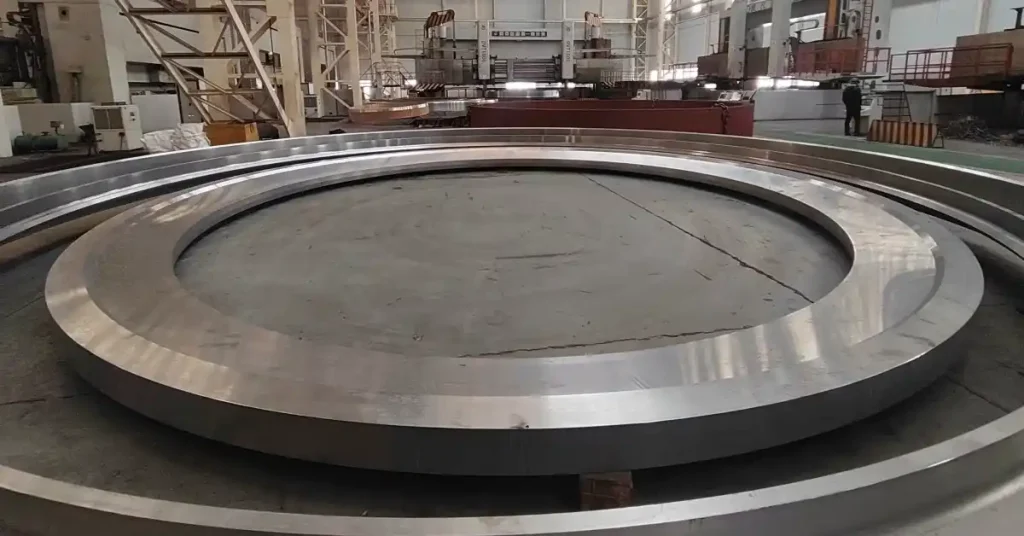
The ring rolling process is the standard industrial method for producing seamless rings used in flanges, bearing races, pressure vessels, wind energy towers, and aerospace structures. Unlike cutting a ring from plate or welding a rolled section into a cylinder, ring rolling works the metal through plastic deformation, producing a continuous grain structure that runs circumferentially around the finished part.
Understanding the process step by step helps engineers write tighter specifications, anticipate lead time drivers, and have more productive conversations with their forge shop.
What Makes Ring Rolling Different From Other Forging Methods
Most forging processes shape metal by squeezing it between dies. Ring rolling is unique because it combines forging forces with a rolling action, reducing wall thickness while simultaneously expanding the ring diameter. The workpiece rotates continuously throughout the process, receiving incremental deformation with each rotation rather than in a single high-force stroke.
The result is a refined, uniform grain structure with no welded seam and no machined-through grain boundaries at the bore or outside diameter. For components under cyclic stress or high internal pressure, this is a significant structural advantage over rings cut from bar or fabricated from plate.
Step 1: Billet Selection and Weight Calculation
The process begins at the steel mill or forging stock warehouse. The starting material is a solid cylindrical billet, cut to a calculated weight. That weight accounts for the finished ring dimensions, the material removed during punching, any flash generated during upsetting, and the machining allowance added to all surfaces.
Material selection at this stage determines the properties of the finished ring. Carbon steels, alloy steels, stainless steels, nickel alloys, and titanium are all commonly ring-rolled. Each has its own forging temperature window and sensitivity to cooling rate, which shapes the rest of the process sequence.
Step 2: Heating the Billet
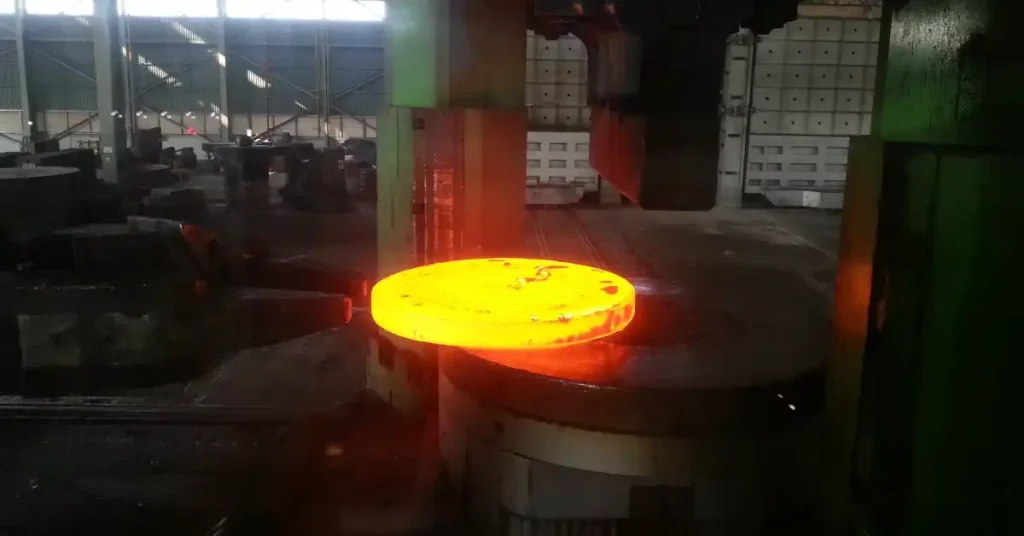
The billet is loaded into a furnace and heated to the forging temperature range appropriate for the grade. For carbon and low-alloy steels this typically falls between 1,150 and 1,280 degrees Celsius. The furnace soak time is calculated based on the billet cross-section to ensure temperature is uniform through the full diameter, not just at the surface.
Temperature control at this stage is critical. Too cold and the steel resists deformation, risking cracks and excessive press load. Too hot and grain growth occurs, which cannot always be corrected by subsequent heat treatment and degrades the mechanical properties of the finished part. For stainless steels and nickel alloys, the forging temperature window is narrower and the process requires more precise control.
Step 3: Upsetting
Once at forging temperature, the billet is transferred to a press where it is upset: compressed axially between flat dies. Upsetting reduces the height of the billet and increases its diameter. This deformation refines the as-cast grain structure of the billet and breaks up any segregation or large inclusions inherited from the casting process.
The degree of upset, expressed as the ratio of the original height to the final height, is a process parameter controlled by the forge shop. Higher upset ratios generally produce better grain refinement but require more press capacity and more careful control to avoid buckling or cracking.
Step 4: Punching the Center Hole
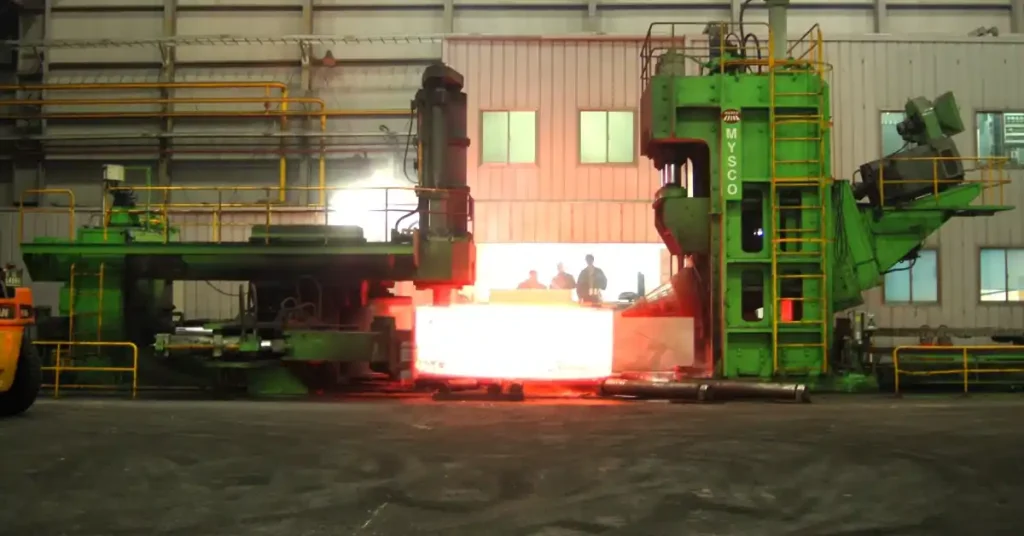
After upsetting, the flat disc-shaped billet is transferred to a punching press. A mandrel punch is driven through the center of the disc, displacing the material outward rather than removing it. The resulting shape, often called a pierced blank or preform, is the donut from which the finished ring will be rolled.
The diameter of the punch determines the starting bore of the ring. The wall thickness and height of the preform are calculated to produce the target finished dimensions after rolling, accounting for the reduction in wall thickness and the increase in diameter that rolling will produce.
Step 5: Ring Rolling
The pierced blank is reheated if necessary and then placed on the ring rolling mill. This is the stage that distinguishes the ring rolling process from other forging methods and gives it its name.
The ring mill has two main rolls. The driven main roll contacts the outside diameter of the ring. The mandrel roll, smaller in diameter, bears against the inside bore. As the main roll rotates and advances toward the mandrel, the wall of the ring is compressed between them. The material displaced by this compression has nowhere to go except outward, causing the ring diameter to increase.
Axial rolls, positioned above and below the ring, control the height. Without them the ring would spread axially as the wall thins, producing a shape with inconsistent height across the diameter. The axial rolls apply a controlled force to maintain the ring height throughout the process.
Rolling is performed in multiple passes. The mill operator, or the automated control system on modern mills, monitors diameter, height, roundness, and wall thickness during rolling and adjusts roll forces and positions accordingly. For large rings, intermediate reheats between passes maintain the material in the forging temperature window.
Step 6: Closing and Rounding
As the ring approaches its target dimensions, the rolling pressure is reduced and the ring is rounded under lighter load. This closing pass improves the circularity of the ring and removes any local ovality introduced by the asymmetric forces during the main rolling passes. Well-controlled closing is important for rings that will be used without further machining of the bore or outside diameter.
Step 7: Controlled Cooling
After rolling, the ring is cooled in a controlled manner. For carbon and alloy steels, air cooling on a rack produces a normalized structure suitable for many applications. For grades sensitive to cooling rate, such as martensitic stainless steels or high-alloy tool steels, the rings may be packed in insulating material or placed in a cooling furnace to slow the cooling rate and avoid cracking or undesirable phase transformations.
Step 8: Heat Treatment
Most industrial ring forgings receive heat treatment after rolling and cooling. The specific process depends on the material and the required mechanical properties specified on the order.
Normalizing refines grain size and homogenizes the microstructure. Annealing softens the ring for machining. Quenching and tempering brings the ring to its target strength, toughness, and hardness. Solution annealing followed by controlled cooling is standard for austenitic stainless steels. The heat treatment condition is part of the material specification and must be documented in the material test report.
If you are evaluating suppliers for this type of work, it is worth reviewing the ring rolling capabilities and available material grades to understand what process documentation and certification can be provided alongside the material.
Step 9: Non-Destructive Testing
Before dimensional inspection and machining, rings for critical applications are subjected to non-destructive examination. Ultrasonic testing checks for internal defects such as voids, inclusions, or laminations that could not be detected visually. Magnetic particle inspection detects surface and near-surface discontinuities on ferritic steel rings. The applicable examination standard, ASME, EN, or a customer specification, is agreed at the time of order and determines the acceptance criteria.
Step 10: Rough Machining and Dimensional Inspection
The as-rolled ring is oversized on all surfaces. Rough turning removes the scale and brings the ring to within a defined allowance of the finished dimensions. At this stage, dimensional checks confirm that the ring is within the required tolerances for further processing.
Finish machining then brings the ring to the final dimensions specified on the drawing. Tolerances achievable on finish-machined rolled rings are comparable to other precision turned components, with diameter tolerances to IT7 or IT8 per ISO 286 routinely achievable on modern CNC lathes.
Lead Time Drivers in Ring Rolling
- Material availability: For standard grades, billet stock is often held. For special grades or large cross-sections, billet lead time can be the longest element.
- Furnace scheduling: Ring rolling mills typically batch similar materials together to optimize furnace utilization.
- Heat treatment: Quench and temper cycles add time, particularly for thick sections requiring long furnace soak times.
- NDT scheduling: Third-party inspection holds add calendar time even when the physical testing is short.
- Finish machining: Complex profiles or very tight tolerances on large-diameter rings extend machining time significantly.
Summary
The ring rolling process converts a solid steel billet into a seamless ring through a sequence of controlled deformation steps, each of which contributes to the final properties of the component. The continuous circumferential grain structure, the refined microstructure from hot working, and the precision achievable through machining combine to make ring-rolled forgings the standard choice for demanding pressure, structural, and rotating equipment applications.