Summary
Forging, casting and machining are three fundamental metalworking processes. Forging shapes heated metal under compressive force. It produces the strongest grain structure. Casting pours molten metal into a mould. It handles complex shapes at lower cost for large volumes. Machining removes material from a solid block using cutting tools. It delivers precision but wastes more material. For critical applications like offshore, energy and pressure vessels, forging typically offers the best mechanical properties. Casting suits complex geometries with lower structural demands. Machining from bar stock works for smaller, simpler parts. Many components combine two or more of these processes.
You need a steel component for an offshore project. It has to handle high pressure. It must survive corrosive fluids. It needs to last for decades.
Do you forge it? Cast it? Machine it from a solid bar?
The answer depends on more than just price. It depends on what the part must do. And what happens if it fails.
How forging works
Forging starts with a steel ingot or billet. The material is heated to around 1,000 degrees Celsius. Then it is shaped under enormous compressive force.
In open die forging, the steel is pressed between flat or shaped dies. The operator controls the shape by repositioning the workpiece between blows. This produces blocks, shafts, rings and discs.
Ring rolling is a specialised form of forging. A pierced billet is placed on a rolling mill. Rollers expand and shape the ring. Diameters can reach 3.5 to 6 metres or more.
What forging does to the steel
Forging is not just about shape. It changes the metal itself.
The compressive force breaks up the cast grain structure. It closes internal voids and porosity. It aligns the grain flow along the direction of stress. The result is a denser, stronger material.
A forged component has better fatigue resistance than a cast one. It has more consistent mechanical properties throughout. And the grain flow can be oriented to match the loading direction.
Near-net shape forging
Modern forges can shape the profile close to the final part. This is called near-net shape forging. You start with less material. You remove less during machining. You waste less. And the grain flow follows the contour of the part.
Scenario: Consider a flange connection. A square cross-section forging requires heavy machining to reach the final shape. That machining cuts through the grain flow. A profiled forging already has the basic shape. Machining only cleans up the surfaces. Less material wasted. Better structural integrity.
How casting works
Casting melts the steel completely. The liquid metal is poured into a mould. It fills the cavity and solidifies into shape.
Types of casting
Sand casting uses a sand mould. It is flexible and cost effective for one-offs. Surface finish is rougher and dimensional tolerances are wider.
Investment casting uses a ceramic mould from a wax pattern. It produces finer details and tighter tolerances. But it is slower and costlier.
Centrifugal casting spins the mould while pouring. It is used for cylindrical shapes like pipes and rings.
Strengths of casting
Casting can produce complex geometries in a single step. Internal passages, intricate shapes and thin sections are easier to achieve by casting than by forging.
For large production runs of identical parts, casting can be more economical. The mould cost is spread across many units.
Weaknesses of casting
The grain structure of a casting is random. There is no grain flow direction. The metal solidifies from the outside in. That creates the potential for porosity, shrinkage cavities and inclusions.
Cast parts generally have lower fatigue strength. They are more prone to hidden defects. Non-destructive testing is essential for critical cast components.
For offshore and subsea applications, castings face additional scrutiny. The random grain structure makes them less reliable under cyclic loading. That is why forging is often specified for pressure-containing or safety-critical parts.
How machining works
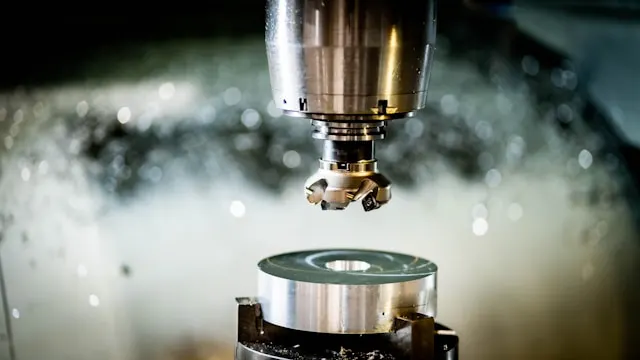
Machining removes material from a solid block or bar. Lathes, mills, drills and grinders shape the component to exact dimensions.
Machining from bar stock
For smaller, simpler components, machining directly from bar stock can be practical. You start with a round or rectangular bar. You cut, turn and mill it to the final shape.
The advantage is speed and simplicity. No mould. No forge. Just raw material and a CNC machine.
The disadvantage is material waste. Everything you cut away is scrap. For large or complex shapes, the material cost adds up fast.
Machining as a finishing process
More often, machining is the final step after forging or casting. The rough shape comes from the forge or foundry. Machining brings it to final dimensions.
For forged components, machining can include turning, boring, milling and grinding. Tight tolerances down to tenths of a millimetre are achievable.
Head to head comparison
Mechanical properties
Forging wins for mechanical properties. The grain refinement and directional grain flow produce the best combination of strength, toughness and fatigue resistance.
Casting has a random grain structure. Mechanical properties are generally lower and less consistent. Porosity and inclusions reduce reliability.
Machined-from-bar parts inherit the properties of the bar stock. For small parts from high quality bar, the properties can be good. But bar stock does not offer the grain flow benefits of forging.
Dimensional accuracy
Machining delivers the best dimensional accuracy. Tolerances within hundredths of a millimetre are routine.
Castings vary by type. Investment casting can achieve reasonable tolerances. Sand casting requires more machining allowance.
Forgings are the least precise as-produced. They require machining to reach final dimensions. But near-net shape forging reduces the amount of machining needed.
Complex geometry
Casting handles complex shapes best. Internal passages, thin walls and intricate features are all possible.
Forging is limited to simpler shapes. Open die forging produces basic forms. Ring rolling produces cylinders and rings. Complex internal features are not possible.
Machining can create complex shapes from solid material. But material waste and machining time increase with complexity.
Material waste
Near-net shape forging minimises waste. The starting material is close to the final shape. Machining removes only a thin layer.
Machining from bar stock creates the most waste. Large parts machined from solid blocks can waste over half the starting material.
Casting has minimal waste in the process itself. But gates, risers and defective parts add to total material usage.
Cost factors
Cost depends on volume, size, complexity and material.
For one-off or low volume production of large parts, forging with machining is often the most cost effective route for high-performance components. The tooling cost is low. The material properties justify the investment.
For high volume production of complex shapes with moderate structural demands, casting becomes more competitive. The mould cost is offset by volume.
For small, simple parts in low volumes, machining from bar stock is typically cheapest and fastest.
Lead time
Machining from stock material is fastest. Material is readily available. No heat treatment may be needed.
Forging requires scheduling at the forge. Heat treatment adds time. Third party inspection adds further time. A typical forged component can take weeks to months.
Casting also requires lead time for mould preparation and production. Investment castings with their ceramic moulds take longer than sand castings.
When to choose forging
Choose forging when:
- The component is safety-critical or pressure-containing
- High fatigue resistance is required
- The application involves cyclic loading
- Standards like NORSOK specify forged material
- The component will operate in harsh environments
- Maximum mechanical properties are needed
Offshore, energy, marine and defence industries typically specify forged components for their most critical applications.
When to choose casting
Choose casting when:
- The geometry is too complex for forging
- Large production volumes justify mould tooling
- Structural demands are moderate
- Internal passages or intricate features are needed
- Cost must be minimised for non-critical parts
When to choose machining from solid
Choose machining from bar stock when:
- The part is small and geometrically simple
- Lead time must be minimal
- Only one or a few parts are needed
- The bar stock material meets all property requirements
Combining processes
Most critical components use more than one process. The most common combination is forging plus machining.
The forge produces the rough shape with optimal grain structure. Heat treatment adjusts the mechanical properties. Then machining brings it to final dimensions.
This combination delivers the best of both worlds. Forged strength with machined precision.
For some applications, cast components receive post-machining for critical surfaces. This is common when the base shape must be cast but sealing or mating surfaces need tight tolerances.
Frequently asked questions
Is forging stronger than casting?
Forged components generally have better mechanical properties than castings. The grain refinement and aligned grain flow of forging produce higher strength, toughness and fatigue resistance. Castings have a random grain structure with potential for porosity and inclusions.
Why not just machine everything from a solid bar?
For large components, machining from bar stock wastes enormous amounts of material. The cost of scrapped material adds up quickly. Forging produces a near-net shape that requires less machining. It also provides better grain structure than rolled bar stock for large cross sections.
Which process is cheapest?
There is no single answer. For large, critical parts in low volumes, forging is often most cost effective when total cost of ownership is considered. For complex shapes in high volumes, casting can be cheaper. For small, simple parts, machining from bar stock is typically the lowest cost option.
Can you forge complex internal shapes?
Open die forging cannot produce complex internal features. The process shapes the exterior of the workpiece. Internal bores and passages are created by subsequent machining. Casting is better suited for complex internal geometries.
What is the typical lead time for a forged component?
Lead times vary widely based on size, material grade and required certifications. Simple forgings from common steel grades can be ready in weeks. Complex offshore forgings in duplex or superduplex steel with third party inspection can take several months.