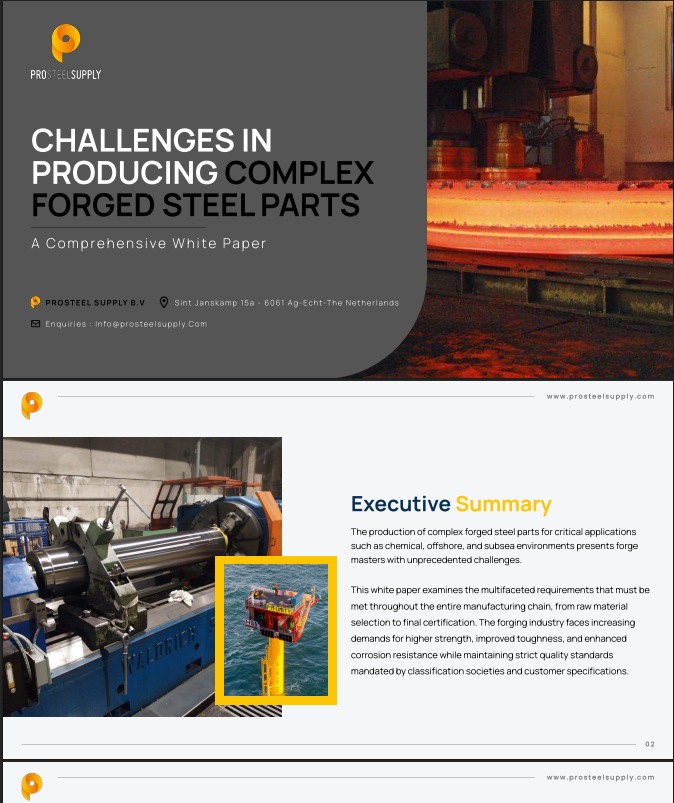
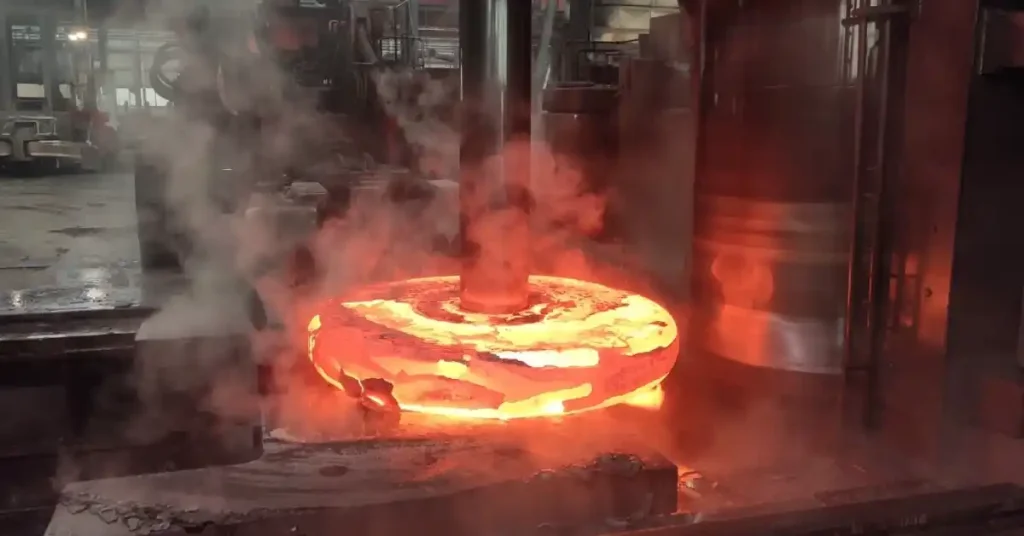
Open die forging has been the foundation of heavy industrial manufacturing for centuries. While closed die forging and near-net-shape processes attract attention for their dimensional precision and production efficiency, open die forging retains a central role in the supply chains of power generation, oil and gas, offshore, marine, and heavy engineering industries. The reason is simple: for large, heavy, and structurally critical components, the advantages of open die forging are not easily replicated by any other process.
This article examines those advantages in detail, explains why they matter for specific applications, and addresses the limitations that engineers and buyers should weigh when selecting a manufacturing route.
What Is Open Die Forging?
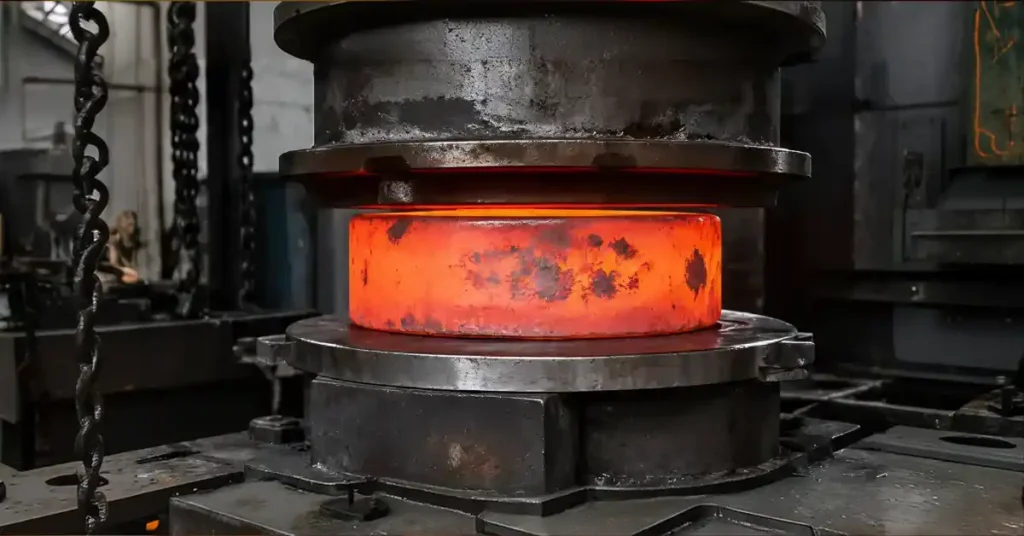
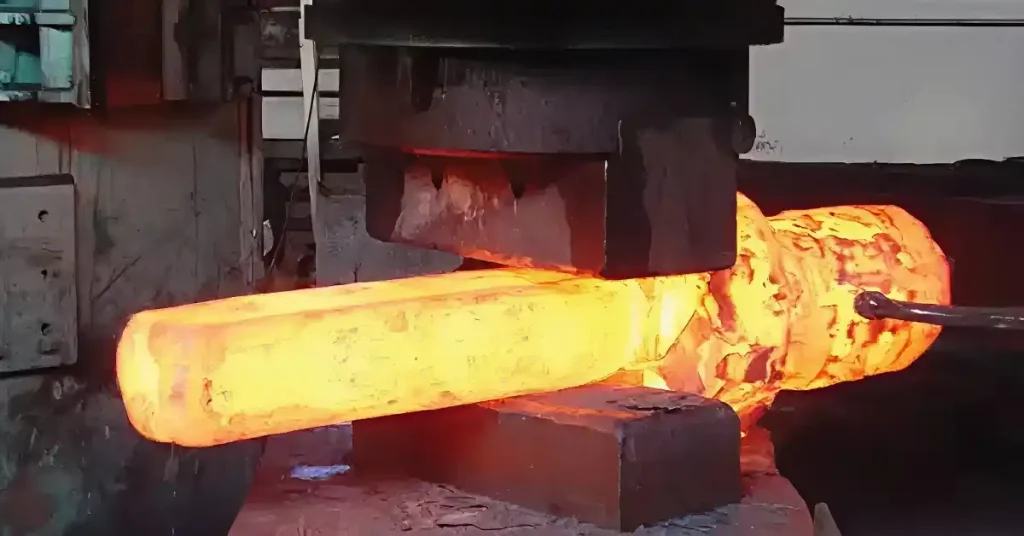
In open die forging, a heated billet or ingot is worked between simple flat, V-shaped, or curved dies that do not enclose the workpiece. The press or hammer applies force repeatedly while the operator rotates and repositions the billet between blows, progressively shaping the material over multiple passes. The final shape is achieved through the cumulative effect of many small deformations rather than a single stroke into a shaped die cavity.
Common shapes produced by open die forging include rounds, squares, hexagons, flat bars, shafts, stepped shafts, hubs, spindles, cylinders, sleeves, and blanks for further machining. More complex shapes such as rings are produced by a variant of open die forging called ring rolling.
Advantage 1: No Practical Limit on Part Size
The most immediate advantage of open die forging is scale. Because the dies do not need to enclose the workpiece, there is no geometric constraint on the size of part that can be produced. Ingots weighing hundreds of tonnes can be forged into large shafts, pressure vessel shells, or nuclear reactor components on heavy forging presses. Components of this size simply cannot be produced by closed die forging or ring rolling.
For industries such as power generation, large marine propulsion, and offshore oil and gas, open die forging is not one option among many but the only viable manufacturing route for their largest and most critical components.
Advantage 2: Low Tooling Cost and Flexibility
Open die forging requires only flat or simply shaped dies, which are inexpensive to manufacture and can be used across a wide range of part geometries and sizes. There is no need for complex, expensive impression dies that must be redesigned for each new part. A forge shop with a standard set of flat and V dies can produce an enormous variety of shapes and sizes without any additional tooling investment.
This flexibility makes open die forging economical at any volume, including single pieces. For spare parts, replacements for worn components, or engineering development parts where the final geometry is not yet fixed, open die forging avoids the tooling commitment required by closed die processes.
Advantage 3: Superior Mechanical Properties Through High Working Ratios
Open die forging allows very high reduction ratios to be applied to the starting material. As the billet is worked and repositioned repeatedly under the press, deformation penetrates through the full cross-section. Large inclusions are broken up, porosity from the casting process is closed and welded shut, and the coarse as-cast grain structure is refined into a fine, uniform forged structure.
This through-working is particularly important for large cross-sections. In a closed die forging of moderate size, the die fills in one or a few strokes, and the deformation is concentrated near the surface. In open die forging of a large shaft or cylinder, the repeated working and repositioning extends the deformation throughout the section, producing properties at the center of the forging that approach those at the surface.
Advantage 4: Material Traceability and Certification
Open die forgings for critical industrial applications are typically produced from verified ingots or billets with full material traceability from the melt. Each forging is associated with a heat number that links it back to the chemical analysis, ladle records, and production data from the steel mill. This traceability is a requirement of the pressure equipment directive, nuclear design codes, and offshore structural standards, and it is easier to maintain in the low-volume, high-attention environment of open die forging than in high-volume automated production.
Industrial buyers procuring components for regulated applications can read more about what documentation and traceability looks like in practice through the open die forging service overview, which covers the grades, size ranges, and certification capability available.
Advantage 5: Short Lead Time for Standard Shapes
For standard shapes in common grades, open die forgings can often be produced from stock billets with relatively short lead times. No tooling needs to be designed or manufactured. The forge schedule can accommodate urgent requirements that would not be possible with closed die processes, where a new part requires weeks or months of tooling preparation before the first forging is made.
For maintenance and breakdown situations where a large shaft or cylinder has failed and plant availability depends on replacing it quickly, the flexibility of open die forging is a significant practical advantage.
Advantage 6: Suitability for a Wide Range of Materials
Open die forging is not limited to carbon and alloy steels. Stainless steels, nickel alloys, titanium, and copper alloys are all regularly open die forged. For specialty alloys that are difficult to process in other ways, the controlled, incremental deformation of open die forging allows the forge shop to manage temperature carefully and avoid the phase transformations or hot cracking that can occur if deformation is too rapid or too severe in a single operation.
Where Open Die Forging Has Limitations
Open die forging produces shapes that require significant machining to reach finished dimensions. The achievable dimensional tolerance in the as-forged condition is wider than closed die forging, and surface finish is rougher. For parts requiring complex three-dimensional geometry with tight tolerances on multiple features, closed die forging or combination routes (open die forging plus closed die forging, or open die forging plus extensive machining) are generally more cost-effective.
Production rate is also lower than closed die forging for equivalent part sizes. Open die forging is fundamentally a low-volume, high-value process and its economics reflect that. Attempting to use it as a substitute for closed die forging on high-volume precision parts would result in higher costs and lower dimensional consistency.
Summary: When to Specify Open Die Forging
- The part is large or heavy, beyond the practical size range of closed die tooling
- Volume is low or the part is a one-off, making tooling investment impractical
- Maximum grain refinement and through-section mechanical properties are required
- The material is a specialty alloy that requires careful, incremental processing
- Full material traceability and extensive documentation are required by code or client specification
Short lead time for a standard shape is needed and no closed die tooling exists.