Closed die forging is the dominant manufacturing process for precision metal components produced at medium to high volumes. From automotive connecting rods to aerospace brackets, valve bodies to surgical instruments, the majority of forged components that require consistent geometry and high mechanical performance are produced by closed die forging.
Understanding how the process works, where it adds value, and what its practical limitations are helps engineers make better process selection decisions and allows procurement teams to evaluate supplier capabilities more effectively.
How Closed Die Forging Works
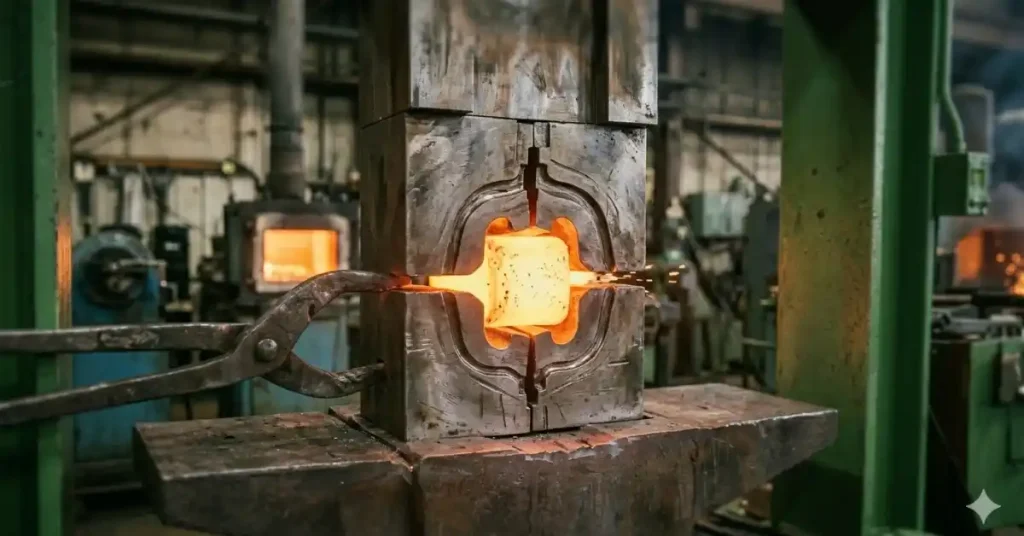
In closed die forging, also called impression die forging, two or more dies are machined with the inverse of the desired part geometry. When the dies close under press force, the heated billet placed between them is forced to flow into and fill the cavity. Material that cannot be contained escapes as flash, a thin fin around the parting line of the dies, which is trimmed away in a subsequent trimming operation.
The dies fully define the shape of the part, which is what distinguishes closed die forging from open die forging, where the dies are simple flat or curved surfaces and the final shape depends on the skill of the operator in repositioning the workpiece.
Modern closed die forging presses range from mechanical presses with capacities of a few hundred tonnes to hydraulic presses capable of several thousand tonnes. The press type and capacity determine the maximum part size and the precision achievable in a single stroke.
The Closed Die Forging Process Sequence
Die Design and Manufacture
Before any parts are made, the die must be designed. Die design for closed die forging is a specialist discipline. The designer must account for material flow during the forge stroke, the location and dimensions of the flash land, the number of impressions required to progressively form the part, and the draft angles needed to allow the forging to be ejected from the die cavity after forging.
Dies are typically machined from hot work tool steels such as H13, heat treated to hardness levels between 44 and 50 HRC to resist the thermal cycling and compressive stresses of forging. High-quality die manufacture is a significant capital investment, which is why closed die forging is most economical at volumes sufficient to spread that cost across many parts.
Billet Preparation
The billet is cut to a weight that matches the die cavity volume plus the expected flash. Weight control is important: too much material and the press forces become excessive; too little and the die does not fill completely, producing an undersized or incomplete forging.
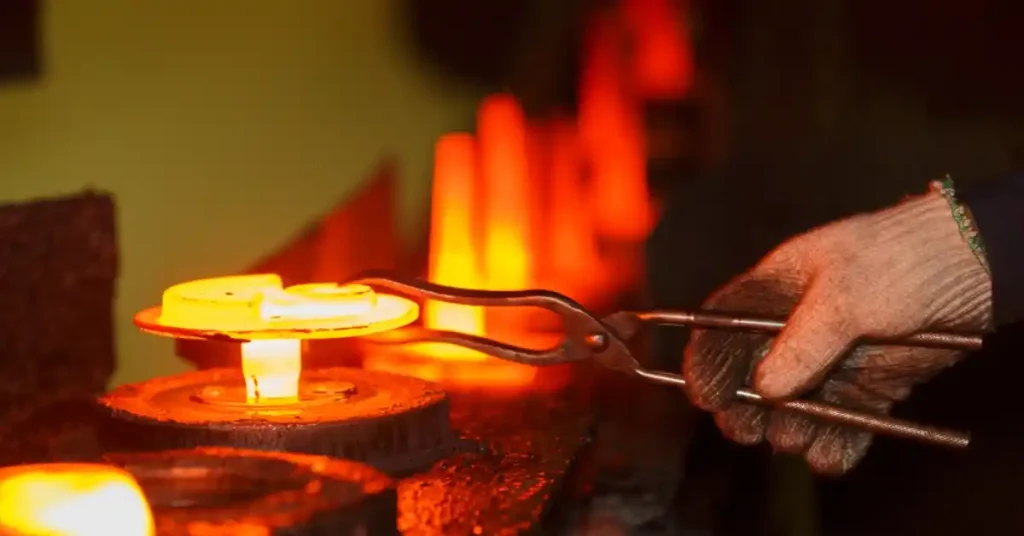
The billet is heated to forging temperature in a controlled furnace or induction heater. For high-volume production, induction heating is preferred because it is fast, controllable, and integrates easily into automated press lines.
Forging
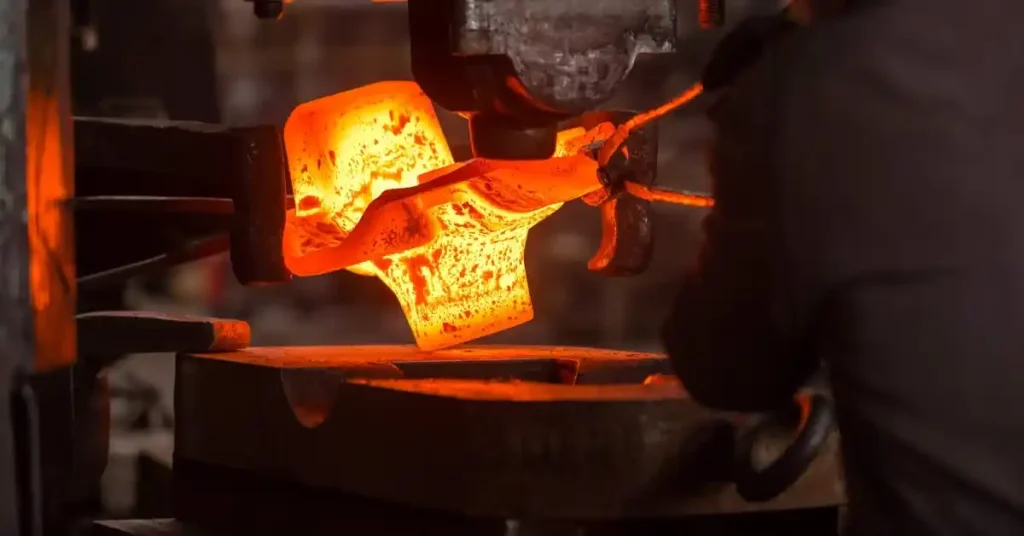
In a multi-impression die, the billet passes through a sequence of cavities, each progressively closer to the finished shape. A blocker cavity pre-forms the material into a shape that distributes it correctly for the finisher. The finisher cavity produces the near-finished shape with the flash. This progressive approach reduces the force required in the finisher and produces a more uniformly deformed part with better grain flow than a single-impression die.
For simpler shapes or smaller parts, a single impression may be sufficient. For complex three-dimensional geometries, three or more impression stages are common.
Flash Trimming
After forging, the flash is removed in a trimming press using a trim die that matches the parting line of the forging. Trimming is typically performed while the forging is still warm, as the flash is harder to remove cleanly after full cooling. Trim flash location and condition is part of the quality check for each batch.
Heat Treatment and Finishing
Depending on the application and material, closed die forgings may be normalized, annealed, or quenched and tempered after trimming. Shot blasting removes scale from the forging surface. For parts requiring tight tolerances, finish machining is performed after heat treatment. For parts used in the as-forged condition, dimensional gauging confirms that all features are within the drawing tolerances.
Advantages of Closed Die Forging
Dimensional Consistency
Because every part is formed in the same die cavity, closed die forgings show very low part-to-part variation in geometry. This is essential for components that must be interchangeable in assembly without selective fitting. High-volume closed die forgings typically achieve tolerances that require little or no machining on non-critical surfaces.
Optimized Grain Flow
The die cavity shapes the material flow, so the grain structure of the finished forging follows the contours of the part rather than running parallel to the bar axis as in a machined component. A well-designed closed die produces a forging where the grain flow reinforces the part in the directions of highest stress, improving fatigue life and impact resistance compared with machined or cast alternatives.
Surface Finish and Near-Net Shape
Closed die forgings leave the press with a defined surface that requires only light cleaning and, for precision parts, targeted machining of mating surfaces and bores. The near-net shape minimizes material waste and reduces the machining time compared with parts machined from solid bar or casting.
High Production Rates
On automated press lines with induction heating and robotic handling, closed die forging can achieve very high throughput rates, making it the process of choice for high-volume components in the automotive and aerospace industries.
Limitations of Closed Die Forging
- Tooling cost: Die design and manufacture represents a fixed cost that must be justified by production volume. For very low volumes or one-off parts, tooling investment rarely makes economic sense.
- Tooling lead time: New die sets require design, machining, heat treatment, and first-article approval before production parts can be made. This adds weeks or months to the first-article lead time.
- Part size limits: Very large parts require very high press forces and correspondingly large, expensive presses. For large and heavy components, open die forging or ring rolling is typically more practical.
- Shape complexity: Undercuts and re-entrant features are generally not achievable in conventional closed die forging without complex multi-piece tooling. Parts with such features may require machining or alternative processes.
Common Applications of Closed Die Forgings
- Automotive: connecting rods, crankshafts, wheel hubs, steering knuckles, suspension components
- Aerospace: structural brackets, engine components, landing gear elements
- Oil and gas: valve bodies, wellhead components, pump housings
- Power generation: turbine blade attachments, gear blanks, shaft couplings
- General engineering: flanges, coupling halves, tool heads
Choosing the Right Supplier for Closed Die Forgings
The quality of a closed die forging depends on die design quality, press capability, process control, and heat treatment competence in equal measure. When qualifying a supplier, request details of their die design and manufacture capability, press tonnage range, furnace calibration records, statistical process control data for key dimensions, and their experience with the specific material and application standard you are working to.
For critical applications, a first-article inspection program with defined hold points for dimensional inspection, non-destructive examination, and mechanical testing should be agreed before production begins.