
When your project depends on material performance, the certificate that accompanies your forged components isn’t just paperwork—it’s your assurance that the material will perform as specified. Yet many purchasers don’t fully understand the crucial differences between material certificate types, potentially exposing their projects to unnecessary risks or costs.
Understanding material certificates can save you significant money while ensuring your components meet critical performance requirements.
In the forging industry, material certificates come in different types, with 3.1 and 3.2 certificates being the most common. The numbers might seem arbitrary, but they represent fundamentally different approaches to quality assurance—and dramatically different cost implications for your project.
Many procurement teams simply specify “material certificate required” without understanding which type they actually need. This lack of clarity can lead to either unnecessary costs or inadequate quality assurance for critical applications.
A 3.1 certificate means the material testing requirements specified in the relevant standard are performed and verified by the manufacturer’s own testing laboratory. The manufacturer tests the material properties—such as tensile strength, impact resistance, and chemical composition—using their internal facilities and personnel.
A 3.2 certificate requires that an independent, third-party inspection body witnesses and verifies the material testing process. Organizations like Lloyd’s Register, DNV, or Bureau Veritas send qualified inspectors to oversee the testing process and verify that results meet the specified requirements.
The third-party inspector must be present during critical testing phases, which means:
The cost difference between 3.1 and 3.2 certificates isn’t just the inspector’s fees—it’s the entire project impact. Here’s what many people don’t realize:
A recent project required 3.2 certification for critical offshore components. The manufacturing was scheduled for completion on a Friday, but the inspector wasn’t available until the following Tuesday. This four-day delay cascaded through the project timeline, ultimately costing more in schedule delays than the original component price.
The key is matching certificate requirements to actual application needs rather than automatically specifying the highest level of certification.
Many projects automatically specify 3.2 certification without evaluating whether it’s necessary. This adds cost and complexity without improving safety or performance in many applications.
Some projects underestimate the importance of proper certification for critical applications, potentially creating liability issues or component failures.
Different regions have different preferences for certification types. What’s standard in Norway may be different from requirements in other markets.
These environments typically require 3.2 certification due to the consequences of failure and the difficulty of replacement or repair.
Critical pressure-containing components often require 3.2 certification, while auxiliary equipment may be suitable for 3.1.
Most standard industrial applications perform well with 3.1 certification from reputable manufacturers.
May require 3.2 certification due to stringent documentation requirements and critical performance needs.
A knowledgeable forging supplier should be able to guide you through certificate selection based on your specific application. They should ask about:
Be wary of suppliers who automatically quote 3.2 certification without understanding your requirements, as this may indicate they’re padding costs unnecessarily.
Material certificates aren’t just paperwork—they’re a critical part of your quality assurance strategy. Understanding the differences between 3.1 and 3.2 certificates allows you to make informed decisions that balance cost, schedule, and performance requirements.
The goal isn’t to choose the most expensive option, but to select the certification level that provides appropriate assurance for your specific application while optimizing cost and schedule performance.
Ready to optimize your material certification strategy? Contact us for a consultation on selecting the right certification approach for your specific requirements.
ProSteel Supply was born from the specialized forge division of Bruk GmbH, one of Europe’s oldest forging operations with facilities in Germany and the Czech Republic.
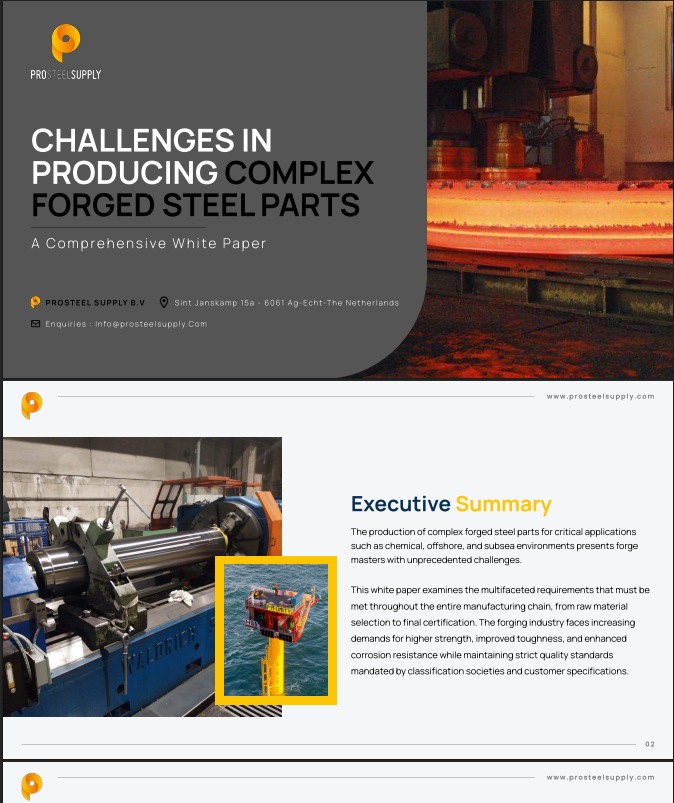
Download our whitepaper and gain practical insights into materials, quality, and supply reliability.