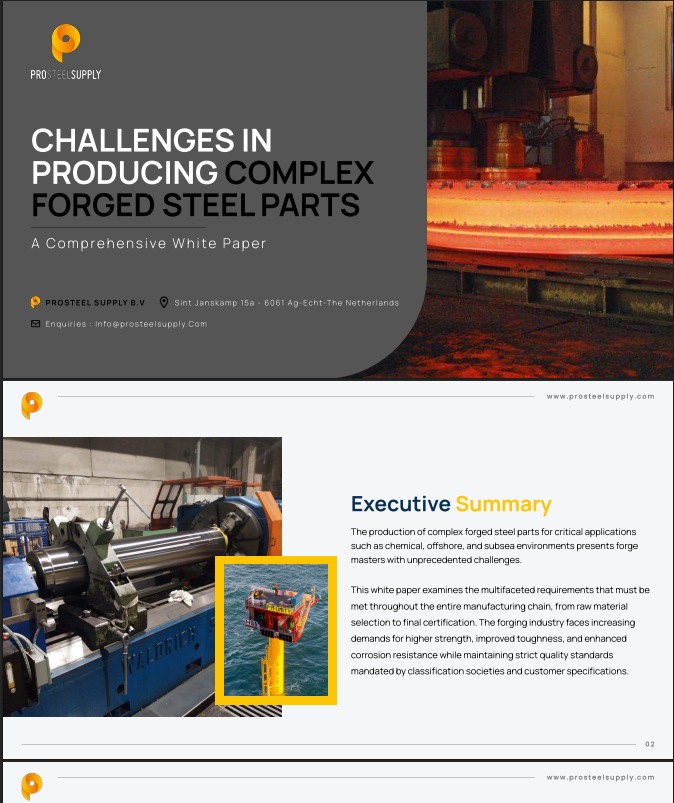
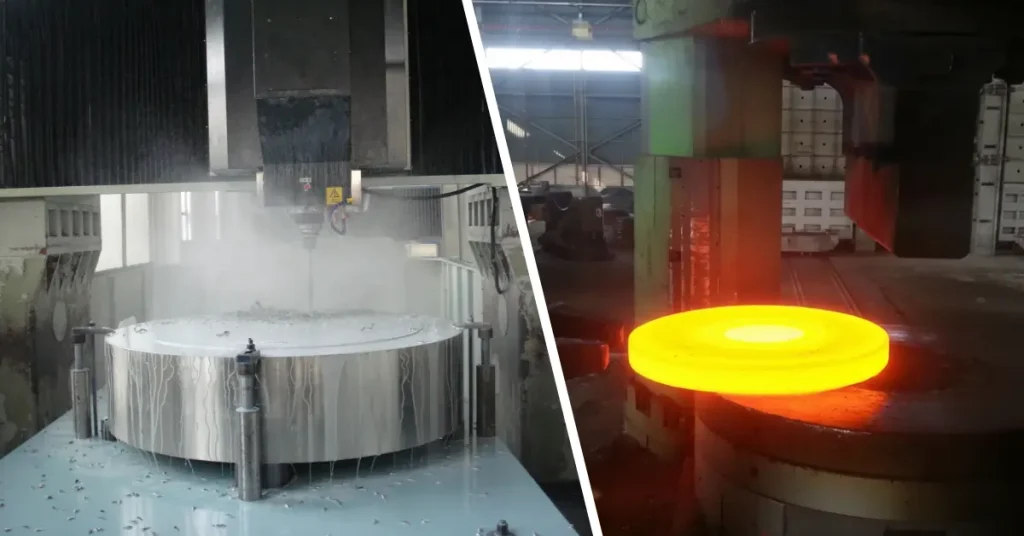
For engineers designing metal components and procurement teams evaluating manufacturing routes, the choice between forging and machining is one that comes up repeatedly. Both processes produce metal parts, but they achieve that result in fundamentally different ways, and the trade-offs between them affect cost, lead time, material efficiency, and mechanical performance in ways that are not always obvious at first glance.
This article compares forging and machining across the dimensions that matter most to industrial buyers, and gives practical guidance on when each process, or a combination of both, is the right answer.
The Fundamental Difference Between Forging and Machining
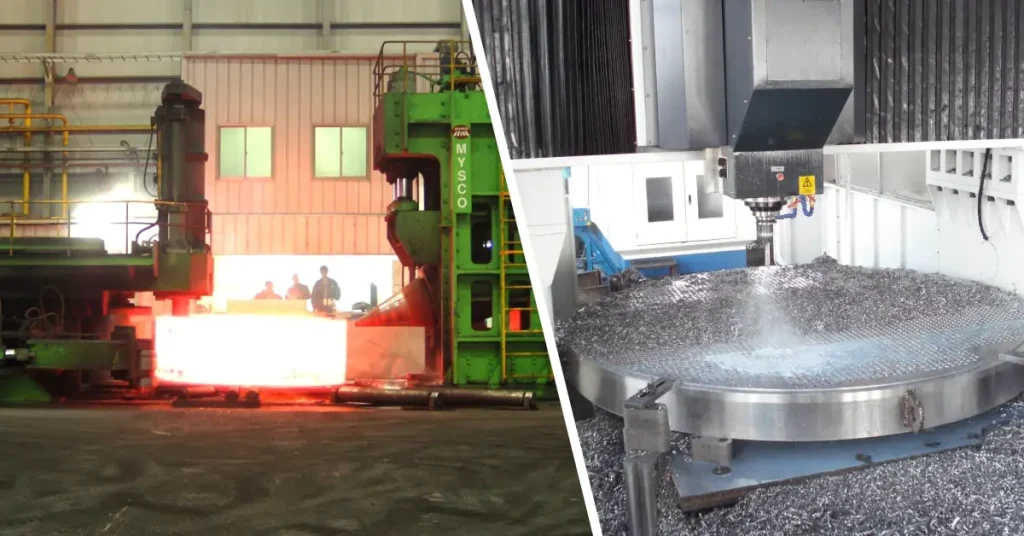
Forging is a primary manufacturing process. It shapes metal by applying compressive force to a heated workpiece, either in an open die or a closed die. The material is deformed plastically, and the resulting grain structure of the metal is reorganized to follow the shape of the part. No material is deliberately removed during forging, though some flash is trimmed and machining stock is added to allow for finishing.
Machining is a secondary or finishing process. It starts with a solid block of material, a forging, a casting, or a bar, and removes material to achieve the desired geometry. The grain structure of the starting material is cut through at every machined surface, exposing the interior of the grain boundaries to the surface.
This difference in grain structure is the key to understanding why forged components and fully machined components made from bar stock behave differently in demanding applications.
Mechanical Properties: The Case for Forging
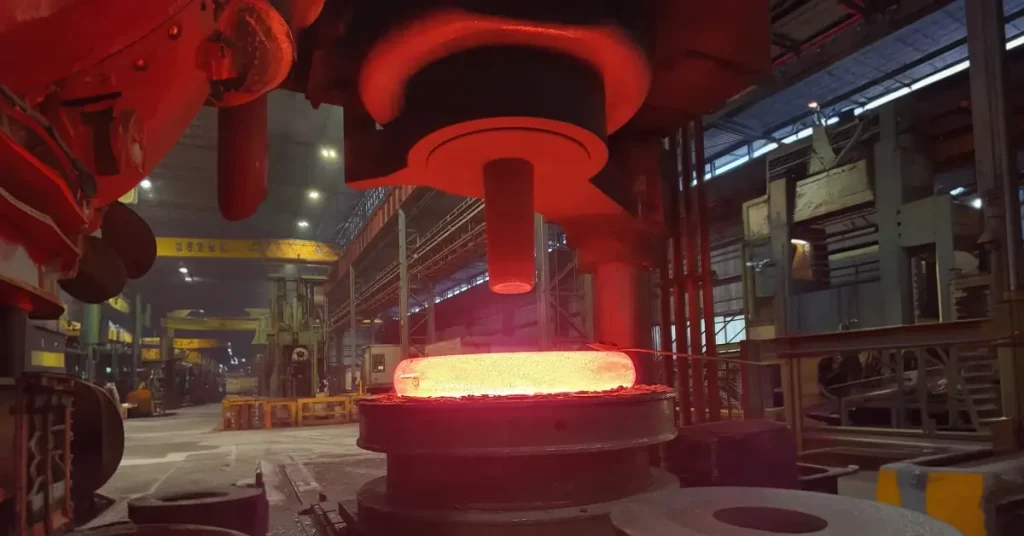
The directional grain flow produced during forging aligns with the shape of the component, reinforcing it in the directions of highest stress. When a machined part is cut from bar stock, the grain runs along the bar axis regardless of the part shape. In a forged flange, the grain runs around the bore and through the flange face. In a bar-turned flange, the same grain that runs parallel to the bore axis is cut transversely at the flange face, creating a potential plane of weakness under tensile loading.
The practical result is that forged parts typically exhibit better fatigue life, higher impact resistance, and greater strength-to-weight performance than equivalent parts machined from bar. For components under cyclic loading or in high-pressure service, this difference is not theoretical but shows up in field performance data and is recognized in design codes.
Where Machining Has the Advantage
Machining, and in particular CNC machining, has clear advantages in other areas:
- Geometric complexity: Internal bores, threaded features, fine surface finishes, and tight dimensional tolerances are all more economically achieved by machining than by forging alone.
- Tooling cost for low volumes: A machined part requires no special tooling beyond standard cutting tools. A closed die forging requires a die set that must be justified by production volume.
- Lead time for prototypes: A machined part can be produced from bar stock in days. A forging requires a forging run, often with minimum order quantities.
- Small and intricate parts: Parts with thin walls, complex internal geometry, or fine detail may be impractical to forge and are better machined.
Material Utilization and Cost
Machining a complex part from solid bar stock removes a large proportion of the starting material as chips. For expensive materials such as titanium, nickel alloys, or high-alloy tool steels, this material loss adds significantly to the part cost. Forging, particularly near-net-shape forging, uses the material much more efficiently by pre-forming the shape before machining, which reduces both material cost and machining time.
For simpler shapes in lower-cost materials, the machining route may be more economical at low volumes because it avoids forging setup costs and minimum order quantities. The break-even depends on material cost, part complexity, volume, and the cost of the forging tooling.
Forging and Machining as Complementary Processes
In practice, most forged components are also machined to achieve finished tolerances and surface finishes. The distinction is between a part that starts as a near-net-shape forging and requires only light machining, versus one that starts as a billet and is machined to the finished shape entirely. The former retains the mechanical advantages of forging while achieving the precision of machining. The latter gives flexibility and avoids tooling investment but sacrifices the grain flow advantage.
For critical components in pressure equipment, rotating machinery, or structural applications, the combination route (forge to near-net shape, machine to finished dimensions) is the dominant choice in industrial supply chains.
Practical Decision Guide
Choose Forging When:
- The part is subject to cyclic fatigue or impact loading in service
- Material cost is high and buy-to-fly ratio matters
- Production volumes justify tooling investment
- The application standard requires forged material (many pressure vessel codes specify forging for certain components)
- Part size is large and bar stock is not available in the required section
Choose Machining From Bar When:
- Volumes are low and tooling cost cannot be justified
- Lead time is critical and no forging stock is available
- The part geometry is too complex to forge economically
- The application loads are light and the grain flow advantage is not critical
Forging Capabilities for Precision Components
If your application requires the performance advantages of forging, our ring rolling and forging services cover a wide range of materials, sizes, and specifications. Our technical team can advise on whether forging, machining, or a combination route is the most cost-effective solution for your component.