Summary
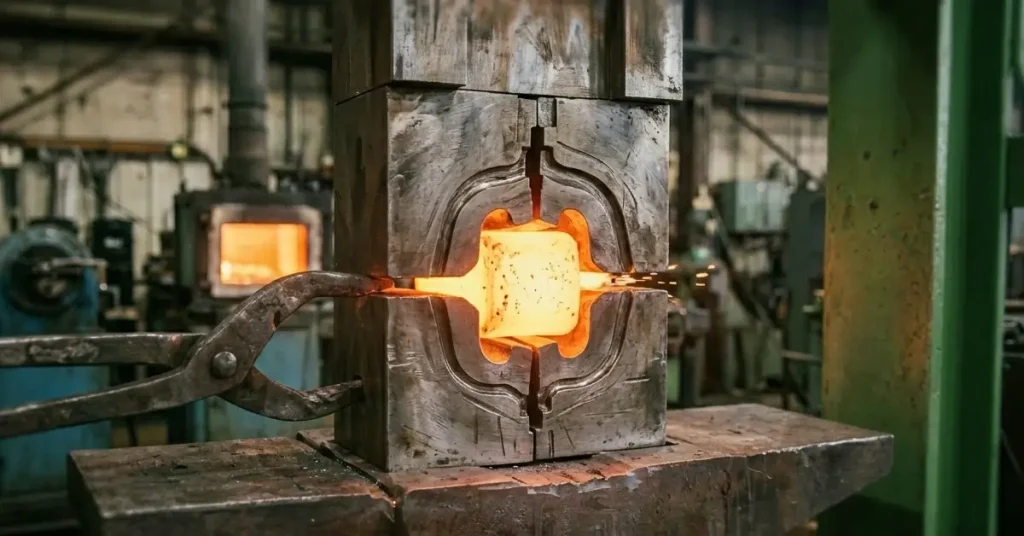
Impression die forging (also called closed die forging) shapes heated metal inside a set of dies that contain the part’s profile. The dies close around the workpiece and force it into shape. This produces parts with tighter tolerances and less machining than open die forging. Open die forging shapes metal between flat or simple dies without enclosing it. It suits larger, simpler shapes in lower volumes. Impression die forging is best for medium to high volume production of smaller, complex parts. Open die forging is best for large, heavy or custom components. Many industrial applications benefit from choosing the right process for the job.
Two forging processes. Same basic principle. Very different results.
One uses shaped dies that enclose the metal. The other works it in the open. Choosing the wrong one costs time, material and money.
Here is how to tell them apart.
What is im4pression die forging
Impression die forging uses a pair of shaped dies. The upper die and lower die together contain the profile of the finished part.
A heated billet is placed between the dies. The press or hammer closes the dies with enormous force. The metal flows into every cavity of the die profile.
Excess metal squeezes out between the dies as flash. This flash is trimmed off after forging. The result is a near-net shape component.
The impression die forging process step by step
Step 1: die design and manufacture. The dies are machined from tool steel. They must withstand extreme heat and pressure. Die design accounts for material flow, flash formation and part ejection. Die costs are significant.
Step 2: billet preparation. A steel billet of the right size and grade is cut to length. The volume must slightly exceed the finished part. The excess becomes flash.
Step 3: heating. The billet is heated to forging temperature. For carbon steels, that is typically 1,100 to 1,250 degrees Celsius. Temperature control is critical for proper material flow.
Step 4: forging. The heated billet is placed in the lower die. The press or hammer drives the upper die down. One or multiple blows shape the metal. Some parts require multiple die sets (preform and finish dies).
Step 5: flash trimming. The flash ring around the part is trimmed in a separate press. The part now has its basic shape.
Step 6: heat treatment. The forging undergoes heat treatment to achieve the required mechanical properties.
Step 7: finishing. Machining, grinding or shot blasting bring the part to final specifications.
What is open die forging
Open die forging shapes metal between dies that do not enclose the workpiece. Flat dies, V-dies or simple shaped tools compress the metal. The operator repositions the workpiece between blows.
There is no cavity to fill. No flash to trim. The shape is built up incrementally. The operator and the press work together.
How open die forging works
A steel ingot is heated in a furnace. It is placed on the lower die of the press. The upper die comes down and compresses the material. The workpiece is turned, flipped and repositioned between blows.
The process can produce blocks, shafts, discs, rings and sleeves. For rings, a separate ring rolling operation follows the initial forging.
Open die presses can be massive. Presses of 10,000 to 16,000 tons are common in large forges. These handle workpieces weighing several tons.
Key differences between impression die and open die
Part size
Impression die: Best suited for smaller to medium sized parts. Typical weight range is a few hundred grams to several hundred kilograms. Die size limits the maximum part dimensions.
Open die: Handles much larger parts. Forgings of several tons are routine. Ring rolling can produce rings up to 6 metres in diameter. There is no practical upper limit for simple shapes.
Complexity
Impression die: Produces complex shapes with features like ribs, bosses, holes and contours. The die cavity determines the shape precisely.
Open die: Limited to simpler shapes. Blocks, cylinders, discs, shafts and rings. Complex features require subsequent machining.
Tolerances
Impression die: Tighter as-forged tolerances. Less machining needed. Near-net shape production is standard.
Open die: Wider tolerances. More machining allowance required. But profile rolling on ring mills can bring some shapes closer to final dimensions.
Tooling cost
Impression die: High. Die sets are expensive to design and manufacture. They also wear and must be replaced periodically. This cost must be spread across production volume.
Open die: Low. Standard flat or simple dies are used for many different parts. No part-specific tooling is needed in most cases.
Volume
Impression die: Economical for medium to high volumes. The die cost per part drops as volume increases. Small batches are rarely cost effective.
Open die: Suited for low volumes and one-off production. Each part can be different. There is no minimum quantity to justify tooling.
Lead time
Impression die: Longer initial lead time due to die manufacture. Once dies exist, production is fast.
Open die: Shorter lead time for first parts. No die manufacture required. But each part takes longer to forge individually.
Grain structure
Both processes improve grain structure compared to casting. But there are differences.
Impression die: Grain flow follows the die cavity contours. Complex parts get grain flow that matches their shape. This is excellent for fatigue resistance.
Open die: Grain flow follows the direction of deformation. For simple shapes, this works well. For parts that need subsequent heavy machining, some grain flow benefits may be lost where material is removed.
Applications of impression die forging
Impression die forging is widely used where moderate volumes of precision parts are needed.
Automotive. Connecting rods, crankshafts, steering knuckles and gear blanks. High volumes justify the die investment.
Aerospace. Turbine blades, structural fittings and landing gear components. Material utilisation and grain flow are critical.
Oil and gas. Valve bodies, fittings, flanges and wellhead components in smaller sizes. Standard catalogue products in large quantities.
General industry. Hand tools, railway components, agricultural equipment and hardware.
Applications of open die forging
Open die forging dominates where parts are large, custom or produced in small quantities.
Offshore oil and gas. Large flanges, hubs, connectors and swivel components. Custom sizes for each project. Duplex and superduplex materials.
Energy. Turbine shafts, generator rotors and pressure vessel shells. Very large, high-integrity components.
Offshore wind. Monopile connection flanges, hydrohammer tooling and transition piece rings. Diameters from 3.5 to 6 metres.
Defence. Gun barrels, armour plates and submarine components. Specialised materials in low volumes.
Chemical and petrochemical. Reactor vessels, heat exchanger tubesheets and custom piping components.
When to choose impression die forging
Choose impression die when:
- Part size is small to medium
- Production volume justifies die cost
- Complex geometry is needed as-forged
- Tight tolerances reduce machining cost
- Consistent repeatability matters across many parts
When to choose open die forging
Choose open die when:
- Parts are large or very heavy
- Quantities are low or it is a one-off
- Custom dimensions change per project
- Simple shapes are acceptable before machining
- Special alloys or large cross sections are required
- Lead time is critical and die manufacture would delay delivery
Can both processes work together
Yes. Some components start with open die forging and finish with impression die operations. A large preform may be open die forged, then transferred to a finishing die for final shaping.
Ring rolling is essentially a hybrid. The initial billet is open die forged (upset and pierced). Then it moves to the ring rolling mill, which shapes it incrementally.
In practice, many forging suppliers specialise in one process or the other. Matching the right forge to the right part is essential.
A note on material properties
Both impression die and open die forging produce better grain structures than casting. The compressive forces close internal voids. They refine the grain. They align the flow.
The specific improvement depends on the forging ratio, temperature control and process design. A well-executed open die forging can match or exceed an impression die forging in mechanical properties. The difference is in geometry and efficiency, not in metallurgical quality.
Frequently asked questions
What is the difference between impression die and closed die forging?
They are the same process. Impression die forging is also called closed die forging. Both terms refer to shaping metal inside a set of dies that contain the part profile.
Is impression die forging stronger than open die forging?
Not inherently. Both processes produce excellent mechanical properties. The grain refinement and void closure benefits are similar. Impression die forging can produce better grain flow alignment in complex shapes. Open die forging produces excellent properties in simpler geometries.
What is the maximum size for impression die forging?
The maximum size depends on the press capacity and die dimensions. Impression die forgings typically range from a few hundred grams to several hundred kilograms. Very large parts exceed the practical limits of impression die equipment and are better suited to open die forging.
Why is open die forging preferred for offshore components?
Offshore components are often large, custom-sized and produced in small quantities. Each project may require different dimensions. Open die forging handles this flexibility without the cost and lead time of dedicated dies. The ability to produce large diameter rings (up to 6 metres or more) is also a key advantage.
How do I decide which forging process is right for my part?
Consider part size, quantity, complexity and lead time. Small, complex parts in medium to high volumes suit impression die. Large, simple parts in low volumes suit open die. A specialist forging supplier can advise on the best route for your specific component.