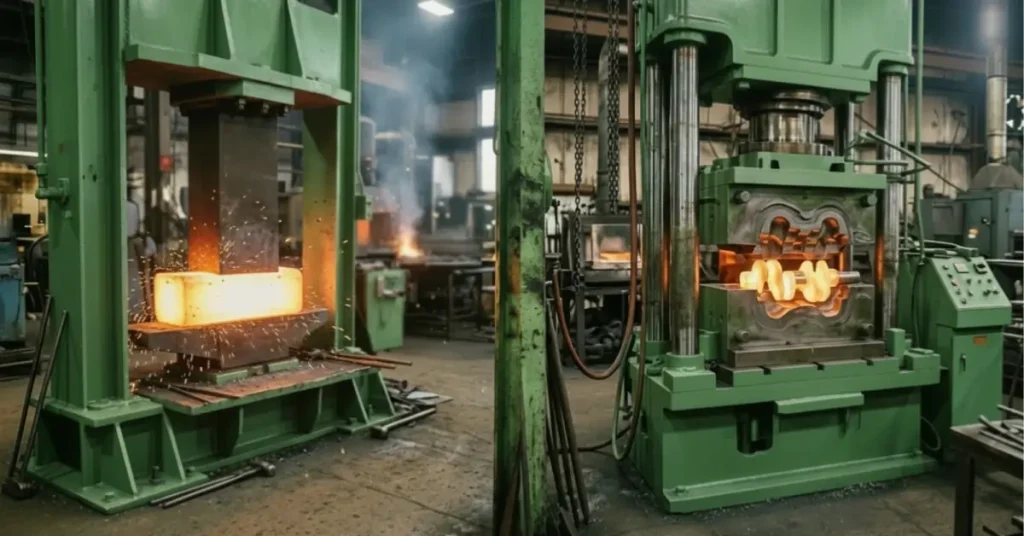
Choosing between open die and closed die forging is one of the first decisions engineers face when a project calls for forged components. The two processes differ in tooling cost, dimensional accuracy, material utilization, and the size and volume of parts they handle efficiently. Getting this decision right early saves time and money throughout the project.
This article explains how each process works, compares them across the criteria that matter most in industrial procurement, and gives practical guidance on which to use for different applications.
How Open Die Forging Works
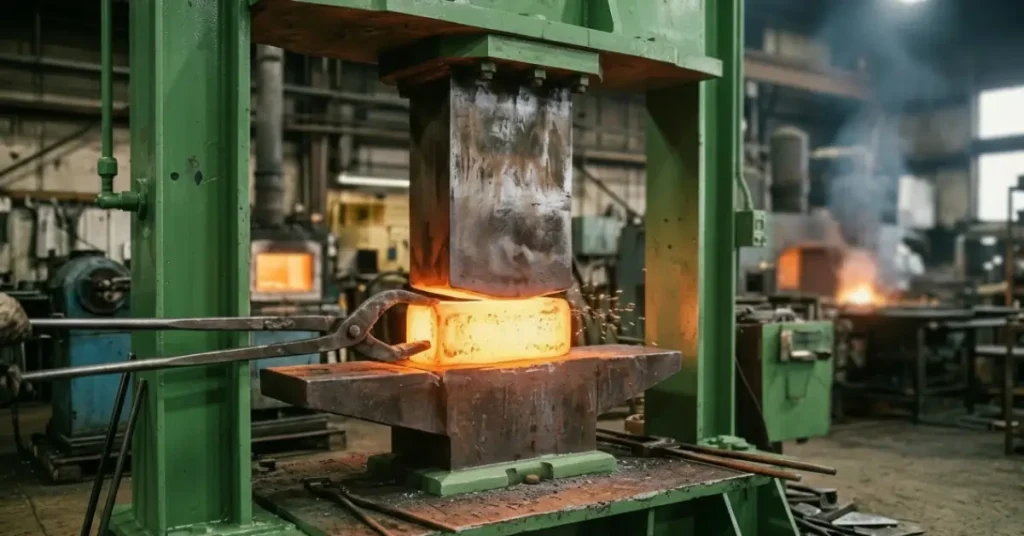
In open die forging, a heated billet or ingot is worked between flat or simply shaped dies that never fully enclose the workpiece. The press or hammer applies force from above, and the operator rotates and repositions the billet between blows to achieve the desired shape. Because the dies are open, material can flow freely in all lateral directions.
This freedom of material flow is both the advantage and the limitation of open die forging. It allows very large parts to be produced with relatively low tooling investment, but it also means that achieving precise net shapes is difficult. Most open die forgings require substantial machining after forging to reach finished dimensions.
Common shapes produced by open die forging include bars, billets, hubs, rings (via ring rolling), spindles, cylinders, and hollow shafts. The process is well suited to heavy industry: shafts for ships and turbines, pressure vessel shells, and tool steel blocks are all typical applications.
How Closed Die Forging Works
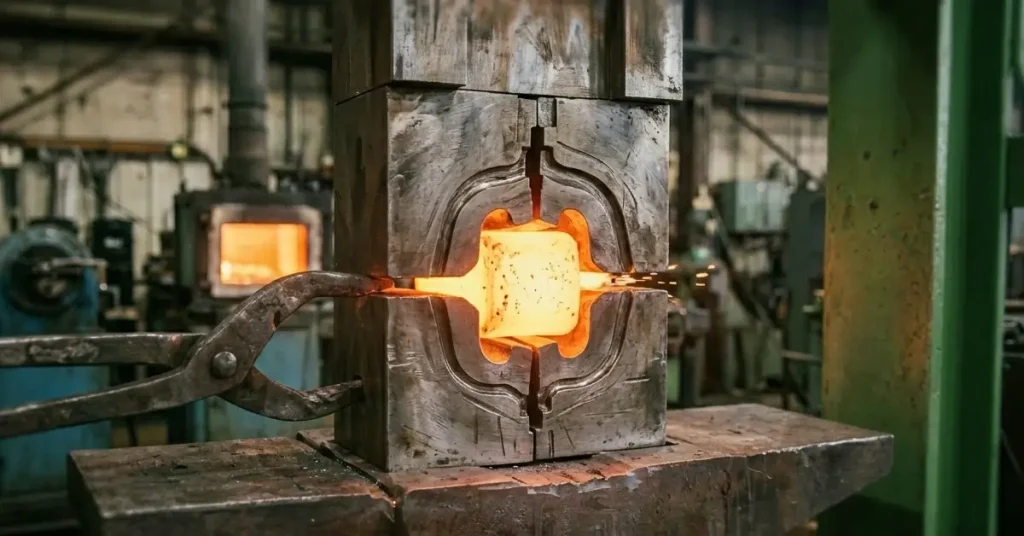
In closed die forging, also called impression die forging, the workpiece is placed in a die cavity that defines the finished shape. When the dies close under force, the metal fills the cavity. Flash, the thin fin of material that squeezes out between the die faces, is trimmed away after forging.
Because the die cavity controls the shape, closed die forgings can be produced to much tighter dimensional tolerances than open die parts. Net-shape and near-net-shape forgings, where little or no machining is needed, are achievable with well-designed tooling and careful process control.
The main constraint is tooling cost. A set of closed dies for a complex part can represent a significant capital investment, which only makes economic sense at production volumes sufficient to amortize that cost. For low-volume or one-off requirements, closed die forging is rarely the right choice.
Key Differences Between Open Die and Closed Die Forging
Tooling Cost
Open die tooling is simple and inexpensive. A set of flat or V-shaped dies suitable for a wide range of part geometries costs a fraction of purpose-built impression dies. Closed die tooling, especially for complex three-dimensional shapes, can cost tens of thousands of euros per die set and requires precision machining and heat treatment.
Part Size
Open die forging handles very large parts, sometimes weighing hundreds of tonnes, that would be impossible to produce in a closed die. Closed die forging is typically used for parts up to a few hundred kilograms, though large closed-die presses can handle heavier components in certain geometries.
Dimensional Accuracy
Closed die forgings achieve significantly better dimensional consistency part to part, because every piece is formed in the same cavity. Open die forgings vary more in dimension and require machining to achieve precise tolerances. For applications where a forging is used as-forged without further machining, closed die is almost always necessary.
Production Volume
Open die is economical at any volume, including single pieces. Closed die forging is most cost-effective at medium to high volumes, where the tooling cost is spread across a large number of parts. The break-even volume depends heavily on part complexity and material.
Material Utilization
Closed die forging wastes some material in the flash, but produces a part that is close to the finished shape so less material is machined away afterward. Open die forgings start further from the finished shape, requiring more machining stock and therefore more material.
Lead Time
Open die forgings can be produced quickly if the material is available, since no special tooling is needed. Closed die forging requires tooling to be designed, manufactured, and proven before the first production part is made, adding weeks or months to lead time for new components.
Which Process Should You Choose?
A few practical rules guide most decisions:
- Large, heavy, one-of-a-kind parts: Open die is almost always the answer. Turbine shafts, large flanges, ingots for further processing.
- Complex near-net shapes at volume: Closed die. Connecting rods, aerospace brackets, automotive components.
- Prototype or development parts: Open die, or sometimes a simplified closed die tool for smaller parts where geometry is critical.
- Cost-sensitive small parts at volume: Closed die, once tooling is amortized.
- Large rings and cylinders: Ring rolling, which is a specialized form of open die forging.
When the decision is not straightforward, request a comparison quotation from your forge shop. A reputable supplier will be transparent about the economics for your specific geometry and volume.
Open Die Forging at ProSteel Supply
Our open die forging service covers a wide range of materials and geometries for industrial buyers who need reliable, traceable forgings with full documentation. Contact our technical team to discuss which process best fits your project requirements.