Summary
Post weld heat treatment (PWHT) is a controlled heating process applied after welding. For carbon steel, PWHT relieves residual stresses and reduces hardness in the heat affected zone. Typical PWHT for carbon steel involves heating to 550 to 700 degrees Celsius and holding for a set time. For stainless steel, the approach differs by grade. Austenitic stainless steels like 316L generally do not require PWHT. Duplex and superduplex stainless steels need solution annealing rather than conventional PWHT. Proper post weld heat treatment prevents stress corrosion cracking, improves toughness and ensures the weld zone meets project specifications.
A forged carbon steel flange is welded into a piping system. The weld looks clean. It passes visual inspection.
Six months later, a crack appears in the heat affected zone.
The cause? Residual stress from welding. No post weld heat treatment was performed. The steel was left in a stressed, hardened condition.
This is preventable. Here is how.
What post weld heat treatment does
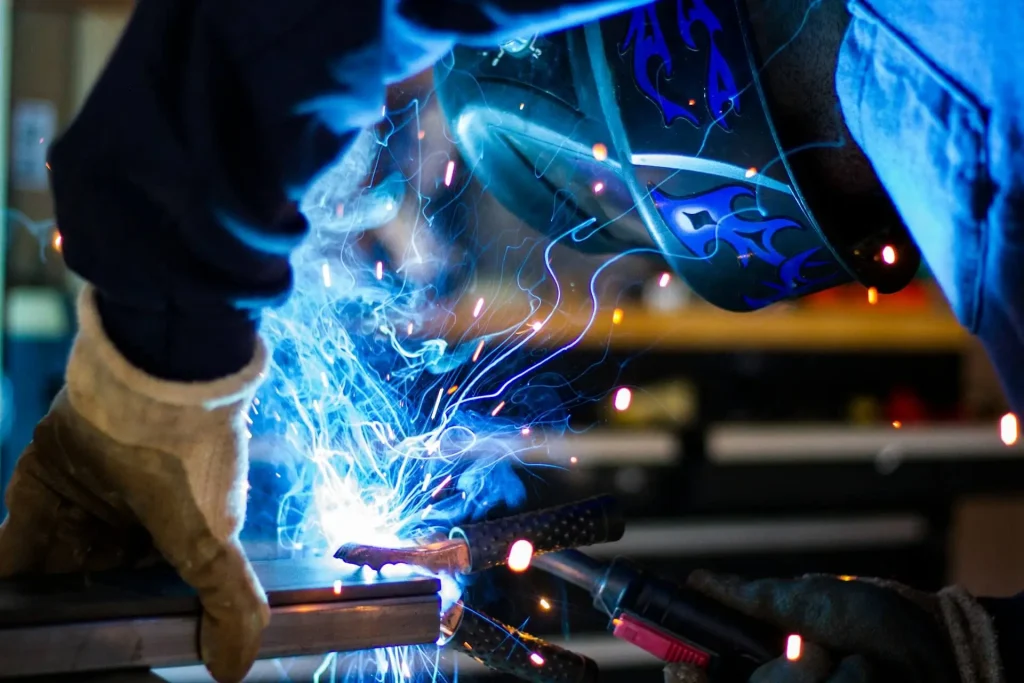
Welding puts intense heat into a small area. The metal melts, fuses and solidifies again. But the zones around the weld cool at different rates.
That creates residual stresses. It also changes the microstructure of the steel near the weld. The heat affected zone (HAZ) can become harder and more brittle than the base material.
PWHT addresses both problems. It heats the welded assembly to a controlled temperature. It holds it there long enough for stresses to relax. Then it cools slowly.
The result is a weld zone with lower residual stress. More uniform hardness. Better toughness. And improved resistance to cracking in service.
Post weld heat treatment of carbon steel
When PWHT is required
Carbon steel is the most common material that needs PWHT. Several factors determine whether it is required.
Wall thickness. Thicker sections develop higher residual stresses during welding. Most codes require PWHT above a certain thickness. [VERIFICATION NEEDED: exact thickness thresholds vary by code, e.g. ASME, EN 13480, PD 5500]
Service conditions. Components in sour service (H2S environments) almost always need PWHT. Hard zones in the HAZ are vulnerable to hydrogen-induced cracking. NACE MR0175 / ISO 15156 set strict hardness limits.
Operating temperature. Low temperature service demands good toughness. PWHT improves impact properties in the HAZ.
Client specifications. Many end clients and project specifications require PWHT regardless of code minimums. Offshore projects in particular often mandate it as standard practice.
How it works for carbon steel
The process follows a controlled cycle.
Heating. The component is heated slowly and uniformly. Heating rates are controlled to prevent thermal shock. Typical rates are limited based on wall thickness.
Soaking. The component is held at the target temperature. For most carbon steels, this is typically between 580 and 620 degrees Celsius. Soak time depends on wall thickness. Thicker sections need longer soaking.
Cooling. After soaking, the component cools slowly. Controlled cooling prevents new stresses from forming. The cooling rate is usually specified by the applicable code or project specification.
What PWHT achieves in carbon steel
Stress relief. Residual stresses drop significantly during the soak period. The steel relaxes at elevated temperature. This reduces the driving force for stress corrosion cracking.
Hardness reduction. The HAZ softens during PWHT. Hard martensitic zones transform into softer, tougher structures. This is critical for sour service compliance.
Improved toughness. Impact properties in the HAZ improve after PWHT. The material becomes more resistant to brittle fracture.
Dimensional stability. Relieving residual stress prevents distortion during subsequent machining or in service. This matters for forged components that need tight tolerances.
Risks if PWHT is skipped
Skipping PWHT on carbon steel welds creates several risks.
Stress corrosion cracking. High residual stresses combined with a corrosive environment can cause cracking. This is especially dangerous in sour service.
Hydrogen cracking. Hard HAZ zones trap hydrogen from the welding process. Without PWHT, this hydrogen can cause delayed cracking hours or days after welding.
Brittle fracture. Hard, stressed weld zones have lower toughness. At low temperatures, the risk of sudden brittle failure increases.
In-service distortion. Residual stresses can cause gradual movement over time. Flanged connections can lose alignment. Sealing surfaces can shift.
Post weld heat treatment of stainless steel
Stainless steel is more complex. The approach depends entirely on the type of stainless steel.
Austenitic stainless steel (316L)
Standard austenitic stainless steels like 316L generally do not need PWHT. The austenitic structure remains tough and ductile after welding. Residual stresses are less problematic because austenitic steels resist stress corrosion cracking better than carbon steel in many environments.
However, there are exceptions.
Sensitisation risk. Prolonged heating between 425 and 870 degrees Celsius can cause chromium carbide precipitation at grain boundaries. This is called sensitisation. It reduces corrosion resistance. Low carbon grades (316L with less than 0.03% carbon) resist this better than standard grades. But extended PWHT in the sensitisation range should be avoided.
When stress relief is needed. If 316L components need stress relief (for dimensional stability or to reduce SCC risk in specific environments), the treatment temperature must be chosen carefully. Either below 425 degrees or above 870 degrees to avoid the sensitisation range.
Duplex stainless steel (22Cr)
Duplex steels are a different story. Their two-phase structure (austenite and ferrite) makes them sensitive to heat treatment.
Generally no conventional PWHT. Modern duplex steels weld well with adapted filler metals like ER2209. Post weld annealing is typically not required. The as-welded structure maintains acceptable phase balance and properties.
When solution annealing is needed. If the welding process disturbs the phase balance significantly, or if intermetallic phases form due to excessive heat input, solution annealing may be required. This involves heating to around 1,050 degrees Celsius and rapid cooling. This is a full heat treatment, not a simple stress relief.
What to avoid. Heating duplex steel to conventional PWHT temperatures (550 to 700 degrees Celsius) is dangerous. This temperature range promotes sigma phase and 475 degree embrittlement. Both destroy toughness and corrosion resistance. Conventional carbon steel PWHT procedures must never be applied to duplex.
The NORSOK steel grades documentation confirms this: heat input must be strictly controlled during welding of duplex steels to maintain the approximately 50/50 phase balance between austenite and ferrite.
Superduplex stainless steel (25Cr)
Superduplex follows the same principles as duplex. But the risks are even higher.
Higher alloy content means a greater tendency to form intermetallic phases. Weld parameters must be tightly controlled. Solution annealing after welding is sometimes specified for critical components.
Again, conventional PWHT in the 550 to 700 degree range is prohibited for superduplex. The consequences of sigma phase formation are severe and can make the material unusable.
6Mo superaustenitic stainless steel
6Mo grades like 254 SMO are fully austenitic. They generally do not need PWHT. However, welding requires special filler metals (nickel-based) to avoid sigma phase formation in the weld metal. The base material tolerates welding well, but the filler metal selection is critical.
PWHT for forged and clad assemblies
Many offshore components combine forging with welding. Forged flanges are welded into piping systems. Forged hubs are welded to pipe sections. Clad components have corrosion resistant alloy welded onto a carbon steel base.
Forged carbon steel with weld connections
When a forged flange or hub is welded into a system, PWHT applies to the entire welded joint. The forging, the weld and the connecting pipe all undergo the heat treatment cycle.
Scenario: A forged carbon steel compact flange is welded into a subsea manifold assembly. The project specification requires PWHT for sour service compliance. The entire welded connection, including the forging, undergoes controlled stress relief. After PWHT, hardness testing confirms the HAZ meets NACE requirements.
Clad components
Cladding involves welding a corrosion resistant alloy (like Alloy 625) onto a carbon steel or low alloy steel substrate. The base material typically needs PWHT. But the cladding alloy may be sensitive to PWHT temperatures.
This creates a conflict. The carbon steel wants stress relief. The cladding overlay wants to avoid prolonged heating that could affect its corrosion performance.
Resolving this requires careful procedure development. PWHT temperatures and hold times must satisfy both materials. This is specialist territory.
Dissimilar metal welds
Joining different materials (for example, carbon steel to stainless steel) adds complexity. Each material responds differently to heat. The PWHT procedure must account for both materials and the transition zone between them.
Quality control after PWHT
Hardness testing
Hardness surveys after PWHT verify that the HAZ has softened to acceptable levels. For sour service, maximum hardness limits (typically 248 HV or 22 HRC for carbon steel) must be met.
Impact testing
Charpy impact tests on procedure qualification specimens confirm that PWHT has improved (or at least maintained) toughness. NORSOK standards require impact testing at low temperatures.
Metallographic examination
Cross-sections of qualification welds are examined under a microscope. This verifies the microstructure is acceptable. For duplex materials, the ferrite-austenite balance is checked. Any intermetallic phases are identified.
Documentation
PWHT is documented with time-temperature records. Thermocouples attached to the component record the actual temperature profile. This documentation becomes part of the quality dossier.
Common mistakes to avoid
Applying carbon steel PWHT to duplex. This is the most dangerous mistake. It can destroy duplex material completely. Each material type needs its own procedure.
Insufficient soak time. The entire cross section must reach temperature. Thick sections need adequate time. Surface temperature alone is not enough.
Uneven heating. Temperature differences across the component create thermal stresses during PWHT. This defeats the purpose. Uniform heating is essential.
Wrong thermocouple placement. Thermocouples must be placed on the component, not in the furnace air. The component temperature is what matters.
Skipping PWHT on thick carbon steel welds. Cost pressure sometimes tempts people to skip PWHT. The consequences of in-service cracking far outweigh the treatment cost.
Frequently asked questions
What is the difference between PWHT and stress relief?
Stress relief is one type of PWHT. It specifically targets residual stress reduction. Other forms of PWHT can include normalizing, tempering or solution annealing. The term PWHT is often used loosely to mean stress relief, but the actual treatment depends on the material and application.
Does 316L stainless steel need post weld heat treatment?
Generally, no. Austenitic 316L retains good properties after welding without PWHT. In specific cases where dimensional stability or SCC resistance is critical, a carefully controlled stress relief may be applied. But it must avoid the sensitisation temperature range.
Can you perform PWHT on duplex stainless steel?
Conventional PWHT (550 to 700 degrees Celsius) must not be applied to duplex or superduplex steels. This temperature range causes harmful intermetallic phase formation. If heat treatment is needed after welding, solution annealing at around 1,050 degrees Celsius followed by rapid cooling is the correct approach.
How long does PWHT take?
Duration depends on wall thickness and the applicable code. Heating and cooling rates are controlled. Soak times increase with thickness. A typical PWHT cycle for a moderate-thickness carbon steel component can take several hours. Large or thick components may need a full day or more.
What happens if PWHT temperature is too high or too low?
Too low and the stress relief is incomplete. Residual stresses remain. Too high and the base material properties can degrade. Over-tempering reduces strength. For carbon steel, the temperature window is well defined by codes. Staying within it is critical.
Is PWHT required for sour service?
In most cases, yes. Sour service environments (containing H2S) attack hard zones preferentially. PWHT reduces hardness in the HAZ to meet NACE MR0175 / ISO 15156 requirements. Without PWHT, the risk of sulfide stress cracking is significant.