Summary
Ring rolling produces seamless rolled rings for offshore wind applications. These include monopile connection flanges, turbine tower rings and installation tooling. Seamless rolled rings are forged from a single billet. A pierced billet is expanded on a ring rolling mill. Diameters can reach 3.5 to 6 metres or more. The process creates a continuous grain flow. That makes rolled rings stronger and more reliable than welded or cast alternatives. For offshore wind, rings must meet strict standards for strength, toughness and dimensional accuracy. Installation tools like hydrohammer adapter rings are also produced by ring rolling.
An installation vessel sits offshore. It costs up to hundreds of thousands of euros per day. A hydrohammer drives monopiles into the seabed. Every tool must fit perfectly.
One failed ring means the vessel goes back to port. Weeks of waiting. Project delays.
That is why ring rolling matters in offshore wind.
What is ring rolling
Ring rolling is a specialised forging process. It produces seamless rings without welds or joints.
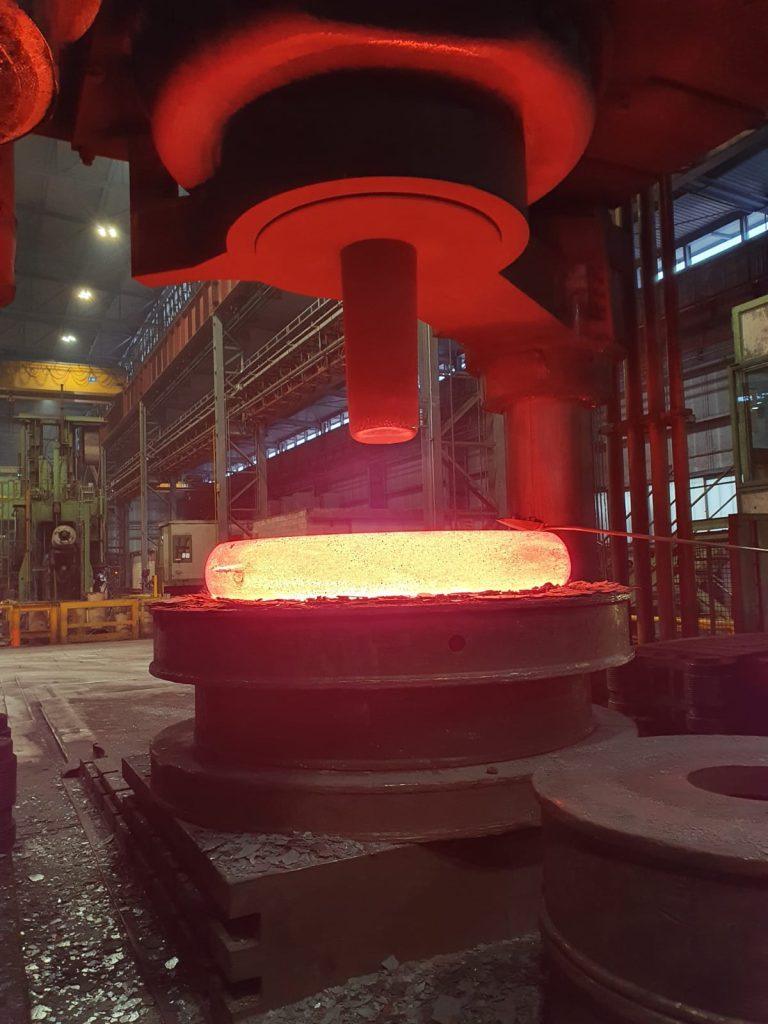
The process starts with a steel ingot. It is heated and upset (compressed). Then a hole is punched through the centre. The result is a thick-walled donut shape.
This donut goes onto the ring rolling mill. The mill has two rollers. One inside the ring. One outside. As they spin, they squeeze the ring wall thinner. The ring grows in diameter.
At the same time, axial rolls control the height. Profile rolls can shape the cross section. A flat bar, a flange profile or a step can all be rolled directly into the ring.
The result is a seamless rolled ring. Continuous grain flow. No weld seams. No joint weaknesses.
Why seamless rolled rings for offshore wind
Offshore wind components face brutal conditions. Salt spray. Cyclic loading from wind and waves. Extreme forces during installation.
A welded ring has a weak point at the weld. A cast ring has a random grain structure. A seamless rolled ring has neither weakness.
The continuous grain flow follows the circumference. That is exactly where the stresses act. This alignment gives rolled rings superior fatigue resistance. For a component that must survive decades of cyclic loading, that matters.
Monopile connection flanges
What they do
A monopile is a large steel tube driven into the seabed. The wind turbine tower sits on top. Between the tower and the monopile, there is often a transition piece. Flanges connect these sections together.
These flanges must be perfectly round and flat. Even small deviations affect alignment. A turbine that sits slightly off-angle creates uneven loading. Over years, that can cause structural fatigue.
Special requirements
Monopile flanges are large. Diameters range from 3.5 to 6 metres. Wall thickness and height vary by project.
Every wind farm has different specifications. Monopile diameters change with water depth and turbine size. That means flanges are rarely standard products. Each batch is project-specific.
Scenario: A new offshore wind farm requires monopiles with a slightly different diameter than the previous project. Standard flanges do not exist. Custom rolled rings must be produced to match the exact specifications. This is where a flexible forge network becomes essential.
Profile rolling
Near-net shape rolling can produce flanges closer to their final form. Instead of rolling a simple rectangular cross section, the mill shapes a profile directly. This reduces machining time. It saves material. And it preserves the grain flow.
The more material you remove by machining, the more you cut through the grain structure. Rolling the profile in means less cutting. Better performance.
Turbine tower rings
Wind turbine towers are assembled from cylindrical sections. Most sections are made from rolled plates. But the flanges that connect sections together are often seamless rolled rings.
These connection rings must carry the full structural load. Every bolt hole must be precisely positioned. The ring must be perfectly circular.
For larger turbines, the forces increase significantly. That drives the demand for higher quality rings with tighter tolerances and better material properties.
Installation tooling
Hydrohammer adapter rings
This is where ring rolling directly impacts project timelines. Monopiles are driven into the seabed using hydrohammers. Between the hammer and the monopile sits an adapter tool.
This tool includes forged rings. They must match the exact diameter of the monopile. Since each wind farm uses different pile sizes, new tools are needed for each project.
These adapter rings take enormous impact forces. Every blow of the hammer transfers through them. They need high strength and exceptional toughness.
Why spares matter
Installation vessels cost vast sums per day to operate. A failed installation tool sends the vessel back to port. Replacement parts can take weeks to produce.
That is why many operators order tools in duplicate or triplicate. Spare sets travel with the vessel. If one tool fails, the next one is ready.
The forged rings in these tools are often the longest lead time items. Ordering early and having spares on hand is not a luxury. It is project risk management.
Material considerations
Installation tools typically use high strength low alloy steels. Quenching and tempering provide the right combination of hardness and toughness.
Some tools use duplex stainless steel when corrosion resistance is needed alongside strength. The choice depends on the tool design, expected service life and whether the tool will be reused.
The ring rolling process in detail
Step 1: ingot selection
Everything starts with the right ingot. The steel grade, chemical composition and ingot quality determine the final properties. For offshore wind applications, strict specifications apply.
Step 2: heating and upsetting
The ingot is heated in a furnace. Then it is upset, meaning compressed to reduce height and increase diameter. This breaks up the as-cast grain structure.
Step 3: piercing
A punch presses through the centre of the upset billet. This creates the hole that will become the ring bore.
Step 4: ring rolling
The pierced billet goes onto the ring rolling mill. The mandrel (inner roller) expands the ring while the main roller compresses the outer surface. The ring grows in diameter as the wall gets thinner.
Profile rolls can shape the cross section during rolling. This is where near-net shape capability makes a difference.
Step 5: heat treatment
After rolling, the ring undergoes heat treatment. The specific treatment depends on the steel grade. Carbon steels may be normalized or quench-and-tempered. Duplex steels require solution annealing.
Step 6: machining
The rolled ring is machined to final dimensions. Rough turning, finish turning, boring, drilling and facing bring the ring to specification.
Step 7: testing and inspection
Mechanical testing, non-destructive testing and dimensional inspection verify the ring meets all requirements. For certified projects, a third party inspector witnesses critical tests.
Quality requirements for offshore wind rings
Dimensional accuracy
Large rings can distort during cooling and heat treatment. Controlling ovality (roundness) and flatness is critical. Advanced forges use controlled cooling and post-rolling sizing operations to maintain tolerances.
Mechanical properties
Yield strength, tensile strength, elongation and impact toughness must all fall within specification. Impact testing at low temperatures is common. The steel must perform in cold North Sea conditions.
Non-destructive testing
Ultrasonic testing checks for internal defects. Magnetic particle or dye penetrant inspection checks surfaces. For critical applications, full volumetric testing is specified.
Traceability
Every ring must be traceable back to the original melt. Material certificates document the full production history. For certified projects, EN 10204 3.2 certificates with third party witnessing are required.
Supply chain considerations
Forge selection
Not every forge can roll rings at offshore wind dimensions. Machines capable of rolling rings up to 6 metres in diameter are specialised equipment. The choice of forge depends on the required size, profile complexity and steel grade.
Lead times
Ring rolling for offshore wind is project-based work. Lead times depend on forge availability, steel supply and inspection scheduling. Planning early reduces risk.
Material sourcing
Steel for offshore wind applications must meet strict chemical and mechanical requirements. Sourcing the right ingot is the first critical step. Getting this wrong means delays downstream.
Frequently asked questions
What is a seamless rolled ring?
A seamless rolled ring is a ring forged from a single piece of steel without any welds or joints. A pierced billet is expanded on a ring rolling mill until it reaches the required diameter. The result is a ring with continuous grain flow and no weld seam.
What size rings can be produced by ring rolling?
Ring rolling can produce rings from small diameters up to 6 metres or more. For offshore wind applications, typical diameters range from 3.5 to 6 metres. The maximum size depends on the specific rolling mill capacity.
Why are seamless rolled rings preferred over welded rings?
Seamless rolled rings have continuous grain flow with no weak points. Welded rings have a heat affected zone at the weld that can be a source of fatigue cracking. For components under cyclic loading, seamless rings offer better long-term reliability.
What materials are used for offshore wind rings?
Common materials include structural carbon steels for general applications, high strength low alloy steels for installation tooling and duplex stainless steel for corrosion-critical applications. The specific grade depends on the application and project specifications.
How long does it take to produce a batch of monopile flanges?
Lead times depend on ring size, steel grade, quantities and required certifications. A typical batch can take several weeks from order to delivery. Factoring in material procurement and third party inspection extends the timeline further. Early planning is essential.